Showing posts with label interview. Show all posts

Friday, January 1, 2016

Mark David Gerson: A Writer's Life Revisited

This is an updated version of an interview that originally appeared on Jean Vallesteros's Book Nerd blog a few years ago. Read the original and related material here

Book Nerd: What inspired you to pen your first novel? Where did you get your ideas for The MoonQuest?

Mark David Gerson: I have written about the birth of The MoonQuest in my Acts of Surrender memoirIn short, though, I had no plans to write a MoonQuest, nor did I have a conscious desire to write a fantasy novel, let alone a trilogy. The MoonQuest birthed itself during a Toronto writing workshop I was facilitating when, in an unprecedented in-the-moment inspiration, I did the same exercise I had presented to participants. What I wrote that evening became the opening scene of the first draft of a novel I knew nothing about. From there, I just kept writing, discovering the story as I went along, until I was done. The StarQuest and SunQuest stories emerged similarly.


BN: What tools do you feel are must-haves for writers?


MDG: An open heart and mind and a willingness to surrender to your story and travel wherever it takes you (and to break all the rules getting there).


BN: How long have you been writing?

MDG: Perhaps the better question would be, "How long did I resist writing?" I often joke that my Muse tricked me into writing, given that for most of my early life, I resisted anything remotely creative. My first jobs out of university were in public relations, where I had to write, even if what I wrote at first was largely formulaic. However, that experience gave me the confidence to try my hand at freelance work and, before I knew it, I was a full-time (self-taught) freelance writer and editor, doing mostly magazine, newspaper, corporate and government work. However, it wasn’t until my early 30s, when the double-whammy of a creative and spiritual awakening knocked me over the head that I began to explore more creative avenues. And it wasn’t until I was 39 that The MoonQuest, my first foray into serious creative writing, began to have its way with me. I’ve been hooked ever since.


BN: What is The MoonQuest about?

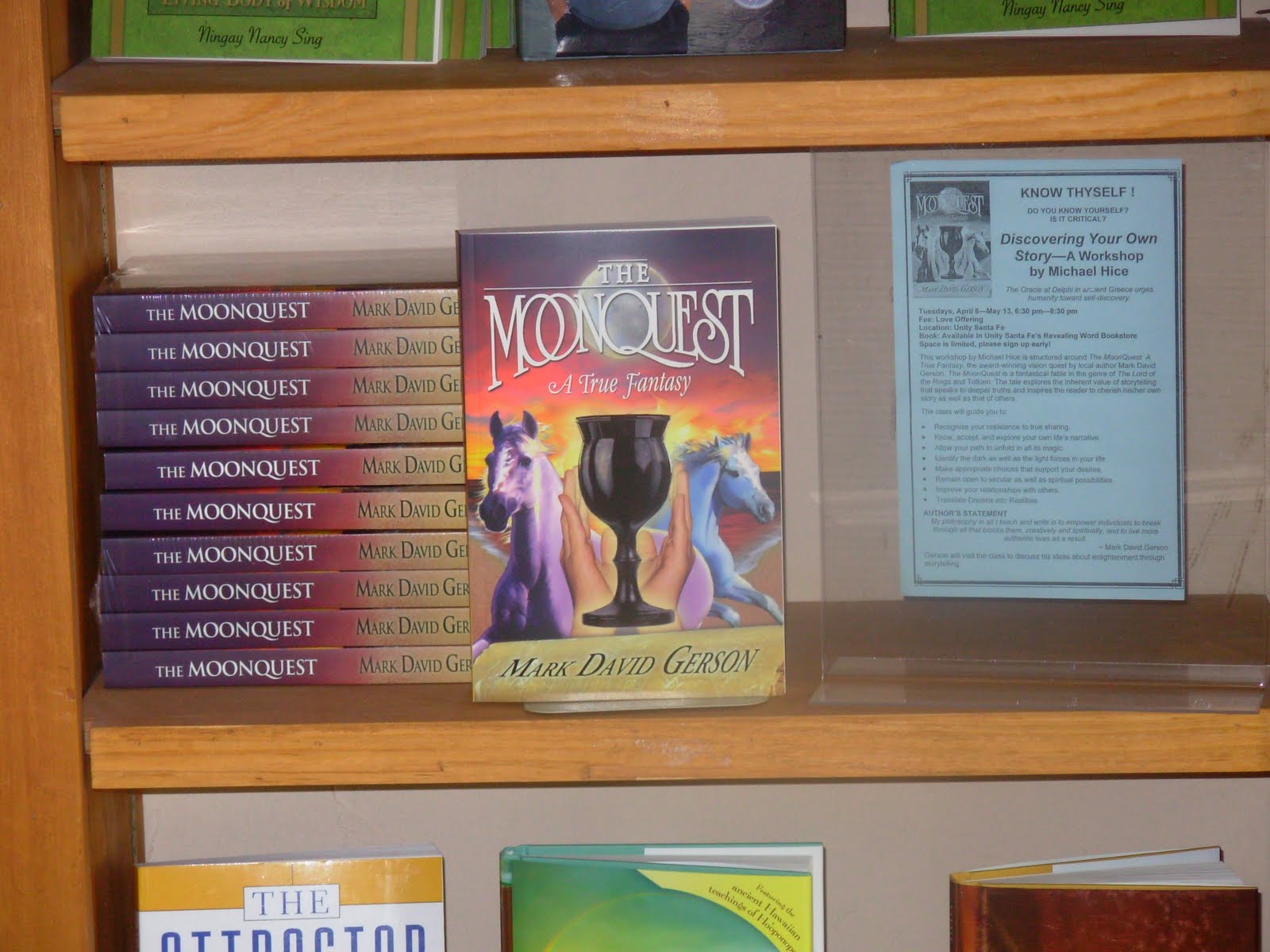
MDG: Imagine a land where storytelling is banned, where storytellers have been put to death, where dreams and visions are outlawed, where imagination has been stripped from the land and its people. This is the Q’ntana of The MoonQuest, a land where, as Toshar, the main character, puts it, "'once upon a time' is a forbidden phrase and fact is the only legal tender." In this land, legend has it, the moon has been so saddened by the silence and tyranny that she has cried tears that have extinguished her light. As a result, the moon has not been seen for many generations. The MoonQuest, then, is the journey undertaken by a reluctant Toshar and his three companions to restore story and vision to the land and to rekindle the light of the moon. Check out the book trailer on YouTube.


BN: Is there anything you find particularly challenging in your writing? Did you learn anything from writing The MoonQuest and what was it?

MDG: When I begin a project, I rarely know the story in advance. When I began The MoonQuest, for example, I knew nothing about it, except what emerged in each day’s writing. I didn’t have a title until about halfway through and I had no idea of the ending until about two-thirds of the way through. It was an experience in surrender: in surrendering unconditional control to my Muse and to the story. And it was tough! It was tough to keep writing with no plot, no outline and not even the remotest clue where the story was taking me. But it taught me how to get out of the way and let the story have its way with me. That’s still how I write — regardless of the form, genre or project. I now do it with much less resistance than I did it on The MoonQuest. But it’s still, sometimes, the most challenging aspect of the work...even as it’s also the most exhilarating and is, for me, the key to the magic!


BN: If you had to choose, which writer would you consider a mentor?

MDG: I’d probably have to say Madeleine L’Engle, author of A Wrinkle in Time. I didn’t discover A Wrinkle in Time and its sequels until I was an adult, when I also discovered, through her nonfiction writings, L’Engle’s deep spirituality, one that informed her creativity and her life. While L’Engle’s spirituality found its expression through the Episcopal Church and mine is largely unstructured, she was a profound influence on my writing and my life. In a sense, she already was a mentor without me knowing it. Now, if she were still alive, I’d like to thank her for that.


BN: What is your work schedule like when you're writing?

MDG: For the most part, I don’t believe in fixed routines. Rather, I operate intuitively — in my writing and in my life. I’m not one of those people who writes at the same time every day or who believes that you should sit down to write regardless of how you feel. While other coaches and instructors recommend applying a regular routine to creative production, that method never works for me for very long. Rather, I remain as in-the-moment as I can and follow wherever the inspiration leads me — in my life as well as in my writing. That way of living and writing is both exhilarating and, at times, terrifying. But it does keep things in an organic balance!


BN: What was one of the most surprising things you learned in creating The MoonQuest?

MDG: Three things, I suppose. The first was that I was actually creative. The second, that the methods I had been teaching (what I call "writing on the Muse Stream": writing nonstop, without thinking, without worrying about where the story was going) actually worked on something as long as a novel. And the third, related to the second, that the story was, truly, way smarter than I was!


BN: How many books have you written? Which is your favorite?

MDG: I have 12 books out: the three books in The Q'ntana Trilogy (The MoonQuestThe StarQuest and SunQuest), five books for writers, including the award-winning The Voice of the Muse: Answering the Call to Write, two memoirs, the inspirational Book of Messages and my latest, a novel called Sara's Year. Plus, I have a Sara's Year sequel in progress. (As well, I have adapted the three Q'ntana stories for the screen.) But asking which is my favorite would be like asking a parent to choose a favorite child. Each is meaningful to me in particular ways and each is a favorite for particular reasons! 


BN: What were your feelings when  you first saw the cover of of your first published book?

MDG: When I opened the FedEx envelope and pulled out my advance copy of The MoonQuest, I burst into tears. I didn’t expect to have that same reaction with my second book, The Voice of the Muse....but I did!


BN: If you gave some of your characters an opportunity to speak for themselves, what would they say?

MDG: What took you so long to get our story out??!? Seriously, I spoke to my characters while writing all three books in the fantasy trilogy. It was some of those conversations that led to some of the most surprising (to me) and powerful scenes in the books.


BN: Are there any tips you would give a book club to better navigate their discussion of The MoonQuest?

MDG: I would invite readers not only to look at the book from the outside, as readers, but to look at the journey the main characters undertake in the book through the lens of their own life experience. In other words, where does The MoonQuest speak to you, personally, in your life? In addition, I have a Reader's Guide to The MoonQuest, available free from my website.


BN: Who is your favorite character in The MoonQuest, and why?

MDG: I’ll answer this question as long as you don’t reveal my answer to the book’s main characters! My two favorite characters, I think, are the two quirkiest...the ones that always make me smile and sometimes make me laugh out loud: the Ferryman (he’s so minor that he has no name) and Pryma, a giant, one-eyed turtle-like creature, who makes a return appearance in The SunQuest.


BN: What was your favorite chapter to write and why?

MDG: Given that the first draft of The MoonQuest was one 400-page chapter, that one’s impossible to answer! As I mentioned earlier, I had no idea what the story was or where it was taking me, so I just kept writing, with no chapter breaks, until the first draft was done. I only added chapter and section breaks in later drafts. I did include chapter breaks in the first draft of The StarQuest and The SunQuest. Although they felt arbitrary at the time, my intuitive sensings must have been fairly accurate as most of those chapter breaks have changed.


BN: Can you see yourself in any of your characters?

MDG: Authors who claim that they don’t see aspects of themselves in all their characters are either lying, blind or woefully un-self-aware. I am in all my characters, even (I hate to admit) the nastiest! In The MoonQuest, though, the character I most identify with is Toshar, the main character whose first-person account the story is. This young man who discovers his stories and his storytelling ability through his MoonQuest journey was very much a metaphor for the creative deepening that writing the book represented for me at that time in my life.


BN: Has a review or profile ever changed your perspective on your work?

MDG: I haven’t had that experience with a review. But I have had it with reader comments. Two experiences in particular were surprising, and gratifying. In the first, a reader told me why the most difficult scenes in the book supported the story’s theme. Those were scenes that had been challenging for me to write, were often challenging for readers to read and, although I intuitively knew they belonged in the book, I couldn’t explain why. In the second instance, a reader brought up a theme that I hadn’t known was there but that made perfect sense to me once he mentioned it. Truly, my books are smarter than I am!


BN: Tell us your most rewarding experience since being published.

MDG: Although winning awards and getting great reviews for both books have been tremendously gratifying and validating, and although having a film producer primed to turn my books into movies is fabulously exciting, what’s most rewarding is when individual readers tell me how one or both of my books has affected them and, in some cases, changed their lives. This moving video, for example, was sent to me by one of my readers.


BN: What are your current projects?

MDG: As I mentioned earlier, I'm working on a sequel to Sara's Year, tentatively titled After Sara's Year. It wasn't a book I planned to write, but so many Sara's Year readers asked for a sequel that I felt I had to give it try. Now, I'm excited to be discovering aspects of the original story and its characters that I didn't know when writing Sara's Year. 


BN: If you couldn’t be an author, what would your ideal career be?

MDG: My secret ambition would be to be a singer! More realistically, I’m also an artist and photographer and would be quite happy devoting more time to those creative pursuits. You can see some of my art and photography on my fine art website, as well as on Instagram.


BN: Do you have any advice for aspiring authors?

MDG: This is for all writers, not just aspiring ones! Trust the story, even if you don’t yet know what it is. Trust your innate creativity. Take it word by word and allow your pen or the keyboard to spell out the story for you. Allow yourself to be the passenger on your creative journey, not the driver. And, of course, get a copies of my books! Seriously, if you can begin to believe that your story always knows best, you’ll never go wrong.


BN: Where is your favorite place to read/write?

MDG: I’m a bit of a cafĂ© freak. I love reading and writing at Starbucks (as my Facebook friends/followers have discovered)!


BN: One of your favorite quotes?

MDG: From The MoonQuest: “You either trust or you do not. There is no halfway in between.”


BN: Where can your readers stalk you?

MDG: I'm easily stalkable in all the usual places! lol
The best place to contact me is either via my website or Facebook, or by leaving comments on my blog.  I’m also on Google+ . FYI: I do my best to respond to all comments and queries...but sometimes it’s just not possible. But I read and appreciate them all.

Wednesday, August 27, 2014

Mark David's Musings on Creativity


This is an updated version of the interview on creativity, the Muse and the creative process that originally appeared a while back ago on author Bill Jones, Jr.'s blog, This Page Is Intentionally Blank


An Interview with Mark David Gerson

The Blank Blog: It’s hard to pigeon-hole you with just one label. You’re author, motivational speaker, screenwriter, mentor, photographer. … How do you see yourself? Is one of these titles more “you” than another?

Mark David Gerson: I’m so glad you’re finding it hard to pigeon-hole me. I hate being slotted into categories and file folders! Seriously, whatever else I have done in my life, it all and always seems to come back to writing. As for the form (author v. screenwriter), I’m not sure that matters so much as the storytelling aspect of the enterprise.

In fact, now that I think about it as I write this (I do some of my best thinking while writing!), perhaps “storyteller” is the common factor in each of those labels. The bottom line is, whether I’m writing, speaking, coaching, mentoring, drawing or photographing, what I’m really doing is telling stories. From that perspective, the death of storytelling that figures so prominently in The MoonQuest, the first book of my Q'ntana Trilogy of fantasy novels, takes on an even more significant and personal dimension.


TBB: For those who haven’t yet read The MoonQuest, can you tell us a little about the story?

MDG: Imagine a land where storytelling is banned, where storytellers have been put to death, where dreams and visions are outlawed, where imagination has been stripped from the land and its people. This is the Q’ntana of The MoonQuest, a land where, as Toshar, the main character, puts it, “‘once upon a time’ is a forbidden phrase and fact is the only legal tender.” In this land, legend has it, the moon has been so saddened by the silence and tyranny, that she has cried tears that have extinguished her light. As a result, the moon has not been seen for many generations. The MoonQuest, then, is the journey undertaken by a reluctant Toshar and his three companions to restore story and vision to the land and to rekindle the light of the moon.


TBB: The MoonQuest has won awards and accolades. Now, I see it is part of a trilogy, which can be both exciting and challenging. How do you balance ensuring you have new stories to tell, with keeping the tone and quality of the original book?

MDG: Yes, The MoonQuest has won five awards, including an Independent Publishers Award Gold Medal IPPY and a New Mexico Book Award. And while no one writes for the awards, they are still wonderfully gratifying and validating.

Fortunately, that balance you asked about is not part of my job description. My job is to listen for the stories that already exist in the airwaves through which my Muse broadcasts and then to put them into words to the best of my imperfect ability. Or put another way, my job is to write the book my story wants written — the way it wants it written.

While I knew from the outset that The MoonQuest would launch a trilogy, and even knew the titles of the sequels early on, I had no idea what The StarQuest and The SunQuest would be about or how they would work with The MoonQuest story. Now that I have completed the two sequels — in other words, now that I finally know the story! — I’m amazed and in awe. My mind could never have worked those puzzle pieces together on its own. Which is why, when it comes to writing, my credos are “the story is smarter than I am” and “the story knows best”!


TBB: Can you tell us about your venture into screenwriting and filmmaking? How was the transition from book to film?

MDG: I’m finding the whole process of working with the same story in multiple forms (novel, screenplay and, now, stage musical) fascinating and illuminating.

I wrote the first draft of The MoonQuest novel in the third person. But all subsequent drafts, as well as The StarQuest and SunQuest novels, are in the first person. Writing screenplay adaptations offers me the rare privilege of telling the same story twice, each from a different point of view: first person in the novel, third person in the screenplay. Adapting the stories a third time, for the stage as a musical, offers new storytelling opportunities and challenges.

As well, each version has fed the others. I wrote the first draft of The MoonQuest screenplay when I thought I already had a completed, publication-ready draft of the novel. But some of the changes I made in the story for the screenplay were so compelling that I went back and retrofitted them into the manuscript. I had similar experiences going back and forth between the The StarQuest and SunQuest novel manuscripts and screenplays. With The SunQuest, I wrote the screenplay first – so that was an adaptation in reverse!

I had never adapted a novel for film when I began The MoonQuest script, let alone tackled any kind of screenplay. And although I read some great books and received some terrific and inspiring instruction at The Screenwriters Conference in Santa Fe (where I was, a few years later, gratifyingly back as an instructor), I approached the adaptation the way I approach all my writing: by trusting that the story itself would guide me. Which it did…well enough that a production company is seeking to produce my screenplay. (I write more about that process in Organic Screenwriting: Writing for Film, Naturally.)


TBB: You must be pretty busy with all your interests. How do you balance your time?

MDG: I take the same intuitive approach to my life as I do to my writing. While other coaches and instructors recommend applying a regular routine to creative production, that never works for me for very long. Rather, I remain as in-the-moment as I can and follow wherever the inspiration leads me — in my life as well as in my writing. That way of living and writing is both exhilarating and, at times, terrifying. But it does keep things in an organic balance!


TBB: In your book, The Voice of the Muse: Answering the Call to Write, you have a chapter entitled, “Thirteen Rules for Birthing Your Book.” I won’t list them all here, because folks need to buy the book. My favorite is “Your book is older than you think.” Can you expound on that a little here?

MDG: My point with this so-called rule (“so-called” because my Rule #1 for everything is that, truly, there are none!) is a version of what I said here earlier, that our stories exist in the airwaves around us. More often than not, they’ve been hovering there for a long time, patiently waiting for us first to take notice, then to take action…“to allow the ideas of your heart,” as I put it in The Voice of the Muse “to find expression through your mind.” That allowing is important. As I suggested in answer to your previous question, creation (like life) is not about forcing things to happen. Creation is about listening for those timeless stories and then letting them sift through us onto the page. Like the God of Genesis, our job is to let creation happen.

By the way, the response to those 13 rules for book-birthing has been so encouraging that I am now working on a new book for writers, Birthing Your Book...Even If You Don't Know What It's About. It will be out this fall.


TBB: I love to ask writers this one. What book(s) do you wish you’d written? Why?

MDG: I could say that I wish I had already written and completed my next novel, a period piece set in my native Montreal. But that wouldn't really answer you. Seriously, though, that’s a question I’ve never considered. And while there are many, many authors I admire and many, many books I have loved over the years, I’m not sure that there any I wish I’d written, because that would mean I would have to have been someone other than myself with a voice other than my own to have accomplished it. With that disclaimer out of the way, the one book — or series of books — that leaps to mind are the Narnia books, probably for their engaging blend of adventure and subtle spirituality.


TBB: For those of us with very shy muses, how would you suggest we coax ours to cooperate more readily?

MDG: You may not like this answer… Muses are never shy. It’s writers who are deaf or, rather, choose not to listen. Muses are never uncooperative. It’s writers who refuse to cooperate. Muses never hold back. Writers hold back all the time!

In those moments when you believe your Muse is not working with you, it’s important to look within. What are we not willing to hear? Which story are we refusing to write? What are we reluctant to face within ourselves that would emerge in a story we are doing our best to ignore? Which belief or way of life is our Muse challenging? Where are we not surrendering unconditionally to our Muse, and to the story it has for us?

Answer those questions, move forward in your writing from those answers, and I’m fairly certain you’ll never encounter a shy, uncooperative Muse again!


TBB: Being a photographer as well as a writer, like you, I take a lot of inspiration from photographs. In effect, the camera is my muse. How did you create the world in The Q’ntana Trilogy?

MDG: I’m not sure I can answer the question, for reasons that may have already become apparent from my previous answers. I didn’t consciously create the Q’ntana worlds. I allowed them to spill through me onto the page. I didn’t plan, plot or prepare. I simply wrote and the worlds created themselves through the words that found their way through me.

In fact, I had no plans to write a MoonQuest, nor did I have a conscious desire to write a fantasy novel, let alone a trilogy. The MoonQuest birthed itself during a writing workshop I was facilitating when, in an unprecedented in-the-moment inspiration, I did the same exercise I had presented to participants. What I wrote that evening became the opening scene of the first draft of a novel I knew nothing about. From there, I just kept writing, discovering the story as I went along, until I was done. The StarQuest and SunQuest stories emerged similarly. (I write about that magical MoonQuest experience in my memoir, Acts of Surrender: A Writer's Memoir.)


TBB: What do you like most about your work? What do you want people to take from it?

MDG: In The Voice of the Muse: Answering the Call to Write, I encourage readers to abandon control, because trying to control the creative process is, at worst, a sure ticket to writer’s block. At best, it produces unimaginative, formulaic results. The same applies in our lives. The more control and rigidity we apply, the fewer miracles we experience.

I love that my work is about inspiring people to open to that kind of freedom, the freedom to live and create from the deepest heart of our being, the freedom to be in the moment — in our lives as much as in our creativity. For isn’t life the ultimate creative act?

If you take one thing from my work, I would hope it would be to see the possibility of that freedom and to discover some first steps toward achieving it.


TBB: You are granted one wish, and are allowed to choose any writer, living or dead, as your mentor? Whom do you choose?

MDG: I’d probably choose Madeleine L’Engle, author of A Wrinkle in Time. I didn’t discover A Wrinkle in Time and its sequels until I was an adult, when I also discovered, through her nonfiction writings, L’Engle’s deep spirituality, one that informed her creativity and her life. While L’Engle’s spirituality found its expression through the Episcopal Church and mine is largely unstructured, she was a profound influence on my writing and my life. In a sense, she already was a mentor without knowing it. Now, if she were still alive, I’d just like to thank her for that.


TBB: How can readers find your work?

MDG: You'll find all my books  – my three Q'ntana novels, my four books for writers and my two memoirs – on most Amazon sites, from select other online booksellers and in all major ebook stores. And my recording, The Voice of the Muse Companion: Guided Meditations for Writers, is on CD on Amazon (and on my website) and as an MP3 download from iTunes, Google Play, Amazon and other online music sellers.


Finally, you can find/contact me through my website and blog and through Facebook and Google+.

Friday, June 13, 2014

Mark David Gerson: A Writer's Life IV


This is a slightly edited version of an interview that Sandy S. Bazinet conducted with me a few months back. Read the full, original post on her blog


What motivates you to write and how did you get started?

I like to joke that my muse tricked me into writing and, in a sense, that’s true. In public school and through most of university, I did everything I could to avoid anything creative, including writing. I opted for math and science courses and steered clear of any non-mandatory courses that involved self-expression.

But my muse had other plans, as I write about in more detail in my memoir, Acts of Surrender: A Writer’s Memoir. Starting in my final years of high school, when I was somehow pushed into taking on responsibility for the publicity for two musical theater productions (and had, of course, to write press releases and other promotional material) and carrying on through my first two post-college jobs (in public relations), I was slowly, subtly and unconsciously transformed into the writer I never thought I wanted to be. When I quit that second job after five years, it was to freelance full-time as a self-taught writer and editor. Still, it would take another dozen years before I moved from a teller of others’ stories as a newspaper, magazine, government and corporate writer to a teller of my own stories, as a novelist.

What I have discovered in the interim is that I can’t not write. I can’t not write any more than I can’t not breathe. I have no need of external motivation. It’s a call I can’t ignore (even on those days when I might prefer to). And it’s a call that I know is heard by others, which is why I titled my second book, The Voice of the Muse: Answering the Call to Write.

What’s most rewarding about writing?

I have two complementary answers to that question. First, writing from a place of total surrender to the work opens me to parts of myself and parts of the world that I wouldn’t otherwise be able to touch. While that’s not always a comfortable journey, it’s always a transformational one and it’s always rewarding. Second, it’s rewarding to know that the work I produce from that way of creating inspires others to do likewise.

What’s your favorite genre and why?

It’s not so much that I have a favorite genre. It’s more that I am drawn to a particular kind of story, regardless of genre — be it in a book, on a stage or in a movie theater: stories that are life-affirming, stories that offer hope, stories that empower, stories that inspire. Those are the kinds of stories I seek to create as well as consume.

Where do your characters come from?

My characters don’t have to “come” from anywhere because, in a sense, they already exist. These are not fictional characters I’m writing about. To me, they are real people — as real as I am. My job as writer is to be their chronicler and biographer, listening for their voices and their stories and setting those to the page for others to read.

Who is an author who inspires you and why?

It’s difficult to single out any one author as an inspiration. But if I must, it would be Madeleine L’Engle. L’Engle is best known for her young adult Wrinkle in Time books, which I didn’t discover until I was in my early 30s — during a time for me of powerful spiritual and creative awakening. But Madeleine L’Engle also wrote several novels for adults, as well as a series of memoirs. All Madeleine L’Engle’s books and stories are infused with the qualities I referred to in my earlier answer: They are life-affirming, empowering, inspirational and hopeful. It’s those qualities — in both L’Engle’s books and her life — that continue to inspire me, not only in my books and my life, but in the ways I teach and coach.

What are you writing now?

I thought I would be taking a well-deserved breather after having completed two new books for writers and having written them back to back – From Memory to Memoir: Writing the Stories of Your Life and Organic Screenwriting: Writing for Film, Naturally.

But because I can't not be writing for long, I have just started my fourth novel! Also, one of these days soon I will return to the stage-musical adaptations of my Q’ntana Trilogy of fantasy stories, The MoonQuest, The StarQuest and The SunQuest, that I began last fall.

What kind of book would you like to be known for?

Be it through my novels, screenplays, stage plays, memoir or books for writers, I would hope to be known for work that inspires, motivates and empowers, for work that encourages people to reignite their passion and creative potential, for work that gives people the courage to believe in themselves and in their creative power.

What has writing taught you about yourself?

My answer to this question is very much linked to my answer to your previous question. That’s because I would wish for my writing to do all the things for others that it continues to do for me. Writing has rekindled a passion for creativity buried so deeply that I didn’t even know it was there. Writing has taught me to believe in my creative potential. Writing has taught me to believe in myself.

How has your life experience influenced your writing?

I would like to answer this question with a story. Again, I tell this story in more detail in Acts of Surrender, but here’s the capsule version…

It was March 28, 1994 and I was leading a writing workshop in Toronto. After I guided participants into a writing exercise, a little voice — the voice of my muse — urged me to do the same exercise myself. I never write during a class I’m teaching, but the call that evening was so insistent that I didn’t dare ignore it. What came out of me in the next twenty minutes would be the opening scene of the first draft of a novel I knew nothing about, a novel that would reveal itself to me in the months of writing ahead as The MoonQuest.

I wrote that first draft in the third person, thinking it was just a story — a story that spoke to me powerfully…but still just a story. Then, a few days before I completed that first draft, I woke up knowing that when it was time to write The MoonQuest’s second draft, I would have to do it in the first person. I also knew why: This fantasy tale set in a make-believe place and in a mythical time where stories were banned and storytellers put to death was my story. Yes, it was told through the metaphor of fantasy, but it was still a very personal story. I knew, too, that I would have to own it and own that fact about it if I were to give it the life it deserved. In one way or another, all my subsequent books have also been distillations of my life experiences.

Another story…

I spent most of my youth and early adult years being creatively blocked. It took a lot courage and some outside help to free me of those blocks. It also took The MoonQuest  Yet, as painful and challenging as those blocks were, they would ultimately feed all my work in the years ahead: all my writing as well as all my teaching. In short, there is no way to separate my creative life from the rest of my life, which is why the 13 “rules” for writing that I include in some of my books are almost identical to the 13 “rules” for living that I have also written about. Why do I put “rules” in quotation marks? Because the first rule in both cases is that there are no rules…not in creativity and not in life!

What encouraging advice can you offer new writers?

This is advice for all writers, not just new writers: Trust your story and trust that your story knows itself better than you do…than you ever will. Trust, too, the chaos of creativity and the magic of creativity. Trust your own creative process. Trust your intuition. Trust yourself.

Where can readers find your books and learn more about you and your work?

All nine of my books are available in both paperback and ebook editions from Amazon and many other major online booksellers and ebook-sellers. My recording of guided meditations for writers is on Amazon.com on CD or as an MP3 download; MP3 versions are also sold on iTunes, Google Play and CD Baby.

For more about me, visit my new website or look me up on YouTube, Facebook, Twitter and Google+.

Bibliography

  • Organic Screenwriting: Writing for Film, Naturally
  • Writer’s Block Unblocked: Seven Surefire Ways to Free Up Your Writing and Creative Flow
  • From Memory to Memoir: Writing the Stories of Your Life
  • The Voice of the Muse: Answering the Call to Write
  • The Voice of the Muse Companion: Guided Meditations for Writers (recording)
  • Acts of Surrender: A Writer’s Memoir
  • The Book of Messages: Writings Inspired by Melchizedek
  • The Q’ntana Trilogy: The MoonQuest, The StarQuest, The SunQuest

Sunday, October 7, 2012

Mark David Gerson: A Writer's Life III

This is a slightly edited version of an interview that Branli Caidryn conducted with me in September. Read the full, original post on his blog

Phoenix Splinter is Branli's debut novel and the first installment in his Project Horizon science fiction series. It was released in August and is available via Amazon and other online booksellers.


Branli Caidryn: What do you think makes a good story?

Mark David Gerson: There may be as many opinions on this one as there are readers and writers! But for me, a good story must engage me, touch me emotionally and be populated by multidimensional characters I care about. Once upon a time, I would read a book through to the end unless it was atrocious. Now, If I don’t develop some degree of emotional investment in the main characters, I’ll put it down. The same applies to movies. It also applies to my own writing. I fully subscribe to director Rob Reiner's statement: "I like telling stories that celebrate life."


BC: How old were you when you wrote your first story? And, what was it about?

MDG: The first — and only — childhood story I remember writing was titled "The Monster Snowplow." (I grew up in Montreal where snowy winters and massive snowblowers were very much part of my kidscape!) Although the story won kudos from my grade school teacher, I was largely shut down as a kid — both creatively and emotionally. I tried another story in my late 20s — a fictionalized version of the peculiar story surrounding my birth (which I detail in my Acts of Surrender memoir). But even then, I wasn’t able to tap into the heart of the story because I wasn’t able to tap into my own heart. That story earned me no gold stars…because I was never able to finish it! It wasn’t until my early 30s that I began to break through my creative blocks and was able to write from an authentic place of feeling. It wasn’t long after that that my first novel, The MoonQuest, was born.


BC: What’s it like to see your work, your novels, being turned into motion picture? What goes through your mind?

MDG: Even when I was writing that tortured first draft of The MoonQuest back in 1994, I saw the story visually and always believed that it would be a movie one day. I expected that some hotshot actor, director or producer would snap up the film rights to my book, hire a screenwriter and produce a blockbuster film. In that fantasy, my only job would be to deposit the producer’s check and then turn up, appropriately tuxedoed, at the star-studded Hollywood premiere, thrilled to see my words and worlds translated into images on a giant screen. I certainly never expected to write the screenplay. But I did — as a sort of spec exercise. Even then, I assumed that my participation in the film version would end once the screenplay was sold. Little did I know that I would end up directing — not just The MoonQuest, but its two Q’ntana Trilogy sequels (The StarQuest and The SunQuest) as well.

What goes through my mind through all this? A roller-coaster ride of excitement, exhilaration, terror, overwhelm, panic, gratitude and humility. I’ve come to realize that my path with The MoonQuest and its sequels was never strictly about being a novel-writer. It was about being storyteller…which is ironic, given that in Q’ntana, The MoonQuest’s mythical setting, stories have been banned and storytellers have been put to death. As this story’s teller, my commitment, as I now see it, is not to any particular form (ie novel v. screenplay). It’s to the story itself, in all its forms. And what is a film director, if not a visual storyteller?


BC: I see you’ve written the script for the film. How much has changed from the book?

MDG: Each of the three Q’ntana screenplays is largely true to its respective book, and I wrote them as I wrote the books: trusting that the greater wisdom of the stories themselves would guide me through the change in form. I’m doing my best to carry that same level of trust and surrender into my role as film director, as well. Back to the screenplays, though… Because the books are written in the first person (a different protagonist for each book), I had some point-of-view challenges that forced me to shuffle a few StarQuest book scenes into The SunQuest screenplay. Or was it the other way around? With each story having two versions — novel and screenplay — even I get confused sometimes about which scene is in which version of which story!


BC: What’s the collaborative effort for the film like? What feelings go through your head as you see others run with your work?

MDG: That’s a really great question and one for which I don’t yet have a real answer. The Q’ntana Trilogy’s film production team has not yet been assembled, so I don’t know how that’s going to work. What I do know is that that transition from flying solo (as writer) to traveling with a team (as director) will require a major adjustment — both creatively and organizationally…not to mention all the control issues I’m sure it will force me to deal with! At the same time, my deepest commitment is not to Mark David the author, Mark David the screenwriter or, even, Mark David the director. It’s to the story. And I’ll do my best to let that commitment be my guiding light in all my dealing with the actors and production teams.


BC: Writer’s block. Believer or denier? As a writing coach what’s your stance and how do you overcome?

MDG: I could write a whole book on this one. Oh, wait. I have, sort of — The Voice of the Muse: Answering the Call to Write. While not strictly about writer’s block, it does address many of the issues that can cause it. It even has a section titled (with tongue somewhat in cheek) “The Myth of Writer’s Block.” I also have a blog post and video on the subject, where I go into much more detail than I can cover here. In short, though, we all have moments when we feel “blocked,” or unable to write. Yet, if you trust in your story, in its inherent wisdom, the words always come. They may not be the words you thought you wanted, they may not show up in the form you expected and they may not manifest according to your preferred timeline. But if you get out of your own way, they will find their way onto the page.

There are lots of ways we can get in our own way and stifle the free creative flow that is as natural as breathing. In my blog post and video, I have broken them down into seven broad categories: Fear, Control, Rhythms & Routines, Perfectionism, Timing, Passion and Self-Respect. But the bottom line is that if you trust that your stories (and the characters that populate them) are smarter than you are, if you cultivate your intuitive listening powers, if you give up your need to be perfect and perfectly in control, and if you write from your passion, you’re much less likely to get stuck. As I write on the blackboard in every classroom I’ve ever taught in: Write. Don’t think!


BC: The Q’ntana Trilogy: I see the first book is available on Amazon. Any hints as to when we can see the next novel?

MDG: Yes, The MoonQuest (Book I) is already out and, I’m pleased to say, an award-winner. And, yes, the paperback edition is on Amazon (with 30 five-star reviews!); ebook versions are also available — for Kindle, Nook, Kobo and iBook. As for The StarQuest (Book II) and The SunQuest (Book III), they are, miraculously, finished. While I don’t have firm publication dates, I expect that they’ll both be available in 2013 — The StarQuest by midyear and The SunQuest by year’s end.


BC: Coffee? Tea? Or both? What fuels you? I notice you’re at Starbucks often. Would it be fair to say they might be listed in the credits of some future work?

MDG: Maybe I should re-title The StarQuest as The StarbucksQuest! I do spend a lot of writing time at Starbucks, less for the coffee than because I like working surrounding by an anonymous cafe-buzz. It’s probably because a writer’s life is largely a solitary one — at least mine has been — and working in cafes gets me out into the world. If you look at the acknowledgments of The MoonQuest, The Voice of the Muse: Answering the Call to Write and my newest book, Acts of Surrender: A Writer’s Memoir, you’ll notice that particular cafes (not always Starbucks!) are always credited as having supported my creative process. I have yet to write acknowledgments for The StarQuest and The SunQuest. But I’m sure Starbucks will get a mention! 

Coffee v. tea? Although I’m largely a coffee drinker these days, certain drafts of certain books have certain demands. For example, when I was writing the last half of the first draft of Acts of Surrender, as well as its second draft, I had no interest in coffee; all I could drink was tea -- Tazo's Awake tea, to be precise!


BC: Ten years from now, where do you see yourself as a writer?

MDG: Ten years from now? I can barely project ahead to ten minutes from now!! I never expected to be a writer — never thought I wanted to be a writer. I never expected or thought I wanted to be a film director. In so many ways, my life has rarely gone as I have planned or expected. So, truly, it’s hard to say. Will I still be writing? Almost certainly. Will I still be directing? Ask me that in about two years, when The MoonQuest movie will be nearly ready for theaters! Beyond that, I do my best to surrender to the story I’m living in much the same way I surrender to the one I’m writing. All I can say is that whatever I’m doing a decade from now, as a writer or otherwise, is probably something I can’t even begin to imagine in this moment!


BC: Alright, legendary coach, any tips for writers out there?

MDG: I have 13 “rules” for writers, which I explain in detail in my book The Voice of the Muse: Answering the Call to Write and outline on the home page of my website. The most important, however, is the first...which applies as fully to living a creative life as it does to creating stories on the page:

“There are no rules: How can there be when creativity is all about breaking new ground and breaking old rules?”


BC: Where can readers find your books and learn more about you and your work?


MDG: Hard-copy editions of The MoonQuest, The Voice of the Muse and The Voice of the Muse Companion CD are available at Amazon.com. Both books, as well as Acts of Surrender: A Writer's Memoir and The Book of Messages: Writings Inspired by Melchizedek, are also sold as ebooks for Kindle, Nook, iBook and Kobo. A downloadable version of the The Voice of the Muse Companion recording is available at CD Baby, Amazon and iTunes. You'll find direct links to all of these on my website's bookstore. For more about the full Q’ntana Trilogy, books and movies, click here.

You can also find me on my website and blog, as well as on YouTube, Facebook, Pinterest, and Google+.

Please "like" my Facebook pages:

Please follow me on Pinterest

Thursday, March 1, 2012

Mark David Gerson: A Writer's Life II

This is an updated version of an interview that appeared last month at Writers Unite, an international online writers' community out of the U.K. 


Writers Unite: Firstly, congratulations on your trilogy becoming a movie! Can you tell us about your Q'ntana Trilogy novels?

Mark David Gerson: Thanks. The Q’ntana Trilogy books consists of The MoonQuest, The StarQuest and The SunQuest. The MoonQuest takes place in Q’ntana, where stories have been banned and storytellers put to death and where the moon, saddened by the silence, has cried tears that have extinguished her light. The quest is to restore story to the land and light to the moon. Because The StarQuest and SunQuest are still in process, I’m not prepared to reveal their plots, other than to say that the evil force behind the tyranny in The MoonQuest spans all three books.


WU: Did you have any goals for this collection when you wrote it — to get published, or just to finish, etc.?

MDG: I have to give you some background before I answer the question. When I began The MoonQuest (or, rather, when The MoonQuest began me), I had no plans for a trilogy, nor did I even have a conscious desire to write a fantasy novel. In fact, I knew nothing about the story, including its title, when the first words found their way out of me onto the page. I tell a longer version of the story on my blog. In short, though, The MoonQuest birthed itself during a Toronto writing workshop I was facilitating when, in an unprecedented in-the-moment inspiration, I did the same exercise I had just presented to participants. What I wrote that evening became the opening scene of the first draft of a novel I knew nothing about. From there, I just kept writing, discovering the story as I went along, until I was done. The StarQuest and SunQuest stories emerged similarly.

I don’t remember now when I knew this would be a trilogy, but I suspect it wasn’t until after I had written The MoonQuest’s second draft. At that point, I knew the titles of the two subsequent books. But I had not the remotest idea what they would be about. As it turns out, Q’ntana (named after the land in which the stories are set) is not a traditional trilogy given that, for the most part, each story focuses on different characters. It’s more a time-bending generational epic, with The StarQuest featuring the daughter of The MoonQuest’s protagonist and The SunQuest featuring her son, although, I said above, the evil Bo'RĂ  K'n character is present in all three books.

As for goals, I would be lying if I said I didn’t care whether or not the books would be published and movies produce. But the truth is that I had to write them, regardless of outcomes or consequences. I had no more choice on my journey than did Toshar, The MoonQuest’s protagonist, on his.


WU: How long did the novels take you to write?

MDG: Not only did I write each novel differently, each took a different length of time to complete.

It took me six months over the course of a year to write the first draft The MoonQuest: two three-month segments of writing broken up by six months when I didn’t work on the book at all. In one of those curious synchronicities that seems to follow me around, I finished the first draft a year to the day after that Toronto writing workshop mentioned above. Although early drafts were completed in the mid- to late 1990s, the book didn't come out until 2007.

In some ways, The StarQuest was the most challenging of the three. Believing (erroneously) that I was finished with The MoonQuest, I began The StarQuest in April 1998. After two aborted attempts to complete a first draft, spread out over a decade, I finally started a new first draft in late 2008 and finished it in July 2009. Last month  (February 2012), I completed what I believe to be a publisher-ready draft of the book and a production-ready draft of the screenplay.

Two things set the trilogy's third story, The SunQuest, apart. The first is that I wrote the screenplay before tackling the novel. With The MoonQuest, I sourced my screenplay adaptation from a largely complete book manuscript. For The StarQuest screenplay, I used that finally completed, ultra-chaotic first draft as my foundation. I decided to challenge myself with The SunQuest by beginning with the screenplay. Once that was done, I wrote a first draft of the novel in what for me was a record-breaking three weeks! 


WU: How long have you been writing?

MDG: Perhaps the better question would be, "How long did you resist writing?" I often joke that my Muse tricked me into writing, given that for most of my early life, I resisted anything remotely creative. My first jobs out of university were in public relations, where I had to write, even if what I initially wrote was largely formulaic. However, that experience gave me the confidence to try my hand at freelance work and, before I knew it, I was a full-time (self-taught) freelance writer and editor, doing mostly magazine, newspaper, corporate and government work. It wasn’t until my early 30s, when the double-whammy of a creative and spiritual awakening whacked me over the head, that I began to explore more creative avenues. And it wasn’t until I was 39 that The MoonQuest, my first foray into serious creative writing, began to have its way with me. I’ve been hooked ever since. 


WU: Did you outline, and if so, how does it help you? 

MDG: Apparently, I’m congenitally unable to outline. Even when I was in high school and was required to turn in an outline with my essay, I always wrote the essay first. I then crafted the outline.

When I begin a project, I rarely know the story in advance. So far, the closest thing I’ve come to an outline was having The SunQuest screenplay in front of me when I wrote the novel. But there was no outline for the screenplay!

When I began The MoonQuest, as I said earlier, I knew nothing about the story, except what emerged in each day’s writing. I didn’t have a title until about halfway through and I had no idea of the ending until about two-thirds of the way through. It was an experience in surrender: in surrendering unconditional control to my Muse and to the story. And it was tough! It was tough to keep writing with no plot, no outline and not even the remotest clue where the story was taking me. But it taught me how to get out of the way and let the story have its way with me. That’s still how I write -- regardless of the form, genre or project. Fortunately, I now do it with much less resistance than I did it on The MoonQuest. But it’s still, sometimes, the most challenging aspect of the work...even as it’s also the most exhilarating and is, for me, the key to the magic!


WU: What was your writing routine for the novels?

MDG: One of my so-called "rules” for writing, abridged on my website from my book on writing, The Voice of the Muse: Answering the Call to Write, is that there are no rules, that what works today may not work tomorrow. From that place, I have no strict routine that I have carried through from project to project.

With the first draft of The MoonQuest, I was so stressed by this notion of surrendering to the story (despite the fact that I had been teaching that philosophy for a few years in workshops!), that I nearly always wrote first thing in the morning, often before getting out of bed. If I wrote first thing, I didn’t spend the rest of the day stressing about writing!

I wrote large chunks of The Voice of the Muse: Answering the Call to Write longhand, in the car...although, to be accurate, I didn’t know at the time that I was writing a book. I thought I was writing stream-of-consciousness, self-inspiration at a time when I was once again stuck on The StarQuest. A few years later, those scribblings would form the basis of The Voice of the Muse book and its companion CD, The Voice of the Muse Companion: Guided Meditations for Writers.

When, in 2008, I began the third version of my first draft of The StarQuest, I was in a unpleasant, time-consuming job. On one hand, I had no time or energy for much other than work. On the other, I knew that writing was my only key to mental and spiritual health. I considered all the oft-written-about options for the time-challenged (writing late into the night, getting up at 4 a.m., etc.) and dismissed them all as, for me, unsustainable. In the end, I chose to set my alarm for a wake-up call 15 minutes earlier than needed and spent those 15 minutes, still in bed, working on  The StarQuest. Some days I wrote a sentence, some days I wrote a paragraph. But I wrote every day. Not only did it keep me sane but when, a few months later, the job ended, the momentum I had achieved with my 15-minutes-a-day routine carried me through to completion. I finished the draft five months later.

With The SunQuest, I felt so driven that I wrote all day every day, six or seven days a week, during the three weeks it took me to complete that first draft. It was November (2011), so I used NaNoWriMo to help motivate me.

A few days after that SunQuest draft was finished, I returned to a memoir manuscript (Acts of Surrender) and, apparently still in that passionate/obsessive flow, finished that first draft, too...also in three weeks.


WU: Has your life changed in anyway since writing the novels?

MDG: That’s a hard question to answer. Nothing about my life is constant. Everything is in unending transition and transformation. While writing is very much a part of that, I’m not sure I can attach particular changes to particular writing projects. I can say, though, that writing The MoonQuest in that day-to-day, in-the-moment fashion freed me to live my life more in that way. Without The MoonQuest, for example, I probably wouldn't now be living in the U.S. I certainly wouldn't be a father. 


WU: How much of the book is realistic?

MDG: The MoonQuest is subtitled "a true fantasy,” but not because it’s conventionally realistic. Set in a mythical time and place, and in a land with two suns and a hidden moon, it can hardly be said to be an accurate representation of any real place.

The architect Frank Lloyd Wright once said that "the truth is more important than facts” and I wholeheartedly agree with that. For me, the notion of "true fantasy” is about the concept of fiction speaking to deeper truths than fact ever can. Although The MoonQuest is not an objectively true story, it is a story about larger truths.

In one sense, there is no such thing as objective fact. Even history -- supposedly a delineation of facts -- is always colored by those who put it forth. You know the saying, "history is always written by the winners.” Even something as apparently factual as your birthday falls on different days depending on which calendar calculates it (ie, Gregorian, Jewish, Muslim, Chinese, Julian, etc.).

However, the human heart at its deepest levels always speaks truth. That’s where our most powerful stories come from. That’s where our truth resides.


WU: What is the message in your book?

MDG: I don’t believe in consciously writing "message books"...even though I have an ebook titled The Book of Messages! Not only did I not know the story as I was writing the three books in The Q’ntana Trilogy, I was also unconscious of their themes. Yet, the themes are there...for in surrendering to the superior wisdom of the books, I freed the stories to delineate and illuminate their own themes, without any interference from me. The obvious themes in The MoonQuest involve censorship, including self-censorship, freedom of expression, transcending creative blocks, and surrender...the same type of surrender I used in getting the book onto the page. Again, I knew none of that during the writing and, I believe, that that’s just as well. By letting the themes emerge as organically as the story did, they are (I hope) not at all heavy-handed and integrate well with the plot.

But there are other themes as well, ones readers discover and share that I knew nothing about. Those are the most exciting for me, as they reveal the book as a living organism that exists independent of me.


WU: What are your readers’ reactions to it?

MDG: Although winning awards and getting great reviews for both The MoonQuest and The Voice of the Muse have been tremendously gratifying and validating, and although having a producer primed to turn the trilogy into a series of feature films is fabulously exciting, what’s most rewarding is when individual readers tell me how one or both of my books has affected them and, in some cases, changed their lives. This moving video, for example, was sent to me by one of my readers. And I have equally wonderful testimonials for both books on my website and on Amazon.


WU: Where can readers find your books and learn more about you and your work?

MDG: Hard-copy editions of The MoonQuest, The Voice of the Muse and The Voice of the Muse Companion are available on my website and Amazon.com. Both books are also sold as ebooks for Kindle, Nook, iBook and Kobo. A downloadable version of the The Voice of the Muse Companion CD is available at CD Baby and on Facebook.

For more about the full Q’ntana Trilogy, books and movies, click here.

You can also find me on my website and blog, as well as on YouTube, Facebook, Pinterest, and Google+.


Please "like" these Facebook pages...
• The Voice of the Muse book
• The MoonQuest movie
• The MoonQuest book
• Mark David Gerson