Showing posts with label the voice of the muse companion. Show all posts

Tuesday, October 17, 2017

A Super-Saver Pre-Holiday Special!

You never know what you'll find when you open your storage unit.

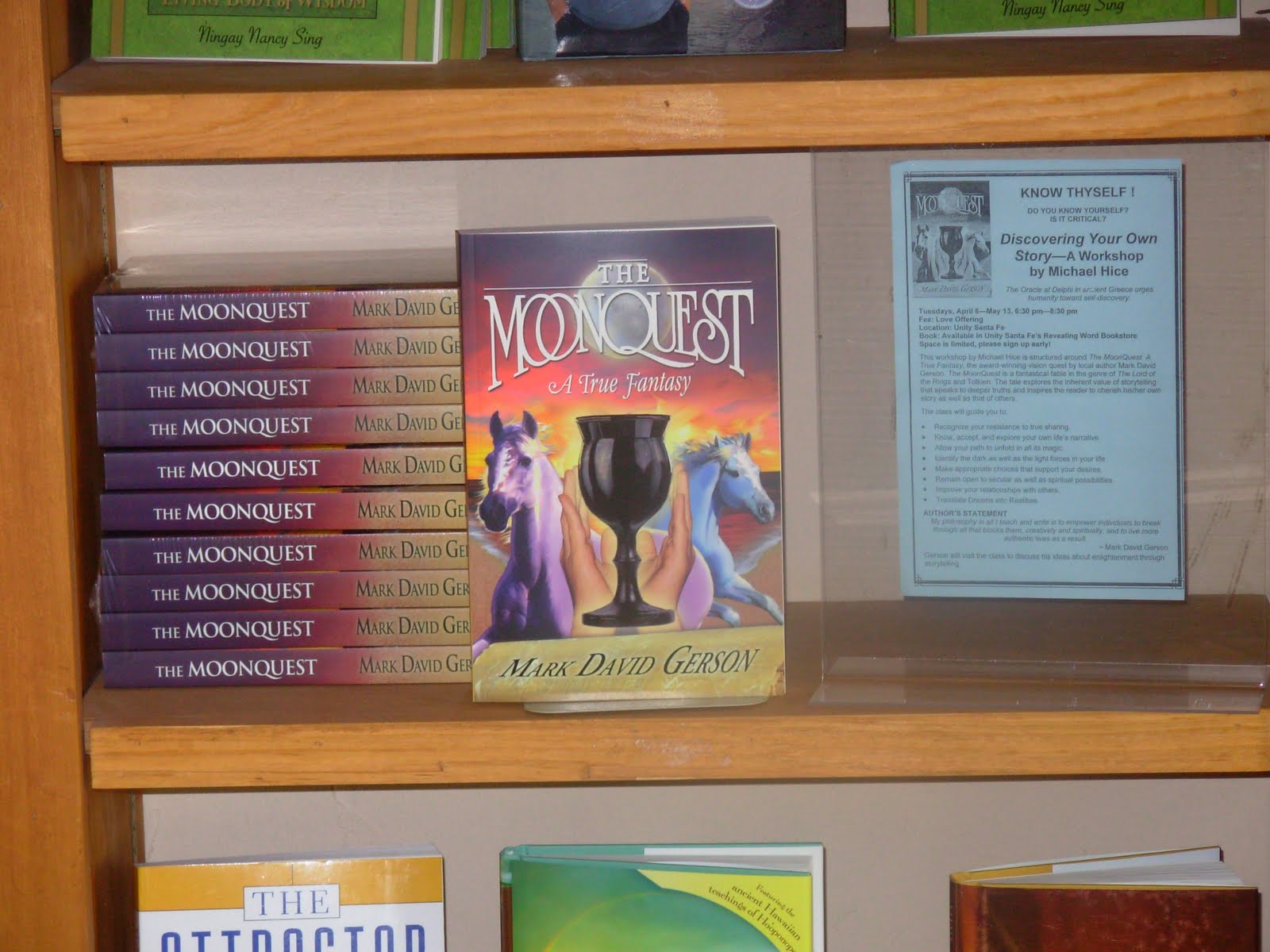
What I found when I rummaged through mine recently was a small stack of unexpected cartons of the first editions of my first two books: The Voice of the Muse: Answering the Call to Write and The MoonQuest (The Q'ntana Trilogy, Book I).

Unexpected, because apart from a handful of "souvenir" copies of these early editions, I didn't know I still had any left. Both first editions were superseded by newer versions a few years back.

With the holidays coming up, I decided that it was the perfect time to take this "storage surprise," throw in some of the few remaining copies of my 2-CD album, The Voice of the Muse Companion: Guided Meditations for Writers, and create a Holiday Supersaver package for you at an unprecedented discount: The Voice of the Muse book and CD at a combined price lower than either sells for separately – $16.77. On top of that, I'm throwing in a bonus copy of The MoonQuest, absolutely free!

GET YOUR COPIES NOW!


Factoring in the free MoonQuest, that's more than 70% off the regular retail price of the two books and CD set!

Even without the killer discount, The Voice of the Muse and MoonQuest books, along with The Voice of the Muse recording on CD, would make ideal gifts for both the writers and fantasy lovers on your holiday list...starting with you! 

But for $16.77, it's an absolute no-brainer!


The Voice of the Muse contains all the practical, inspirational and motivational content that turned it into an instant classic and got it named Best Writing Book of the Year not once but twice. As for The MoonQuest, the critically acclaimed story is an even more relevant allegory today than it was when it was first published more than a decade ago.


These two books were my first award-winners and are still my best-sellers. And The MoonQuest is on its way to the big screen as the first film in an epic fantasy trilogy!

So you won't want to miss this deal!! 

A few "fine print" details...
• This promotion will continue through Oct. 31...or until these last copies of the two books are gone. Because I have a limited number left, I urge you to act now! (I'm also running low on the CD version of The Voice of the Muse Companion; so its days of availability are also numbered.)
• I cannot sign copies of these super-sale editions. If you prefer signed copies, please order the new editions from www.markdavidgerson.com/books.
• To make the process more efficient, all books will be shipped within 7 days of the end of the promotion.


Photo of Storage Unit: Original Flickr image by MyBiggestFan; licensed under Attribution 2.0 Generic (CC BY 2.0); https://creativecommons.org/licenses/by/2.0/legalcode. This version additionally processed in Luminar.

Friday, January 1, 2016

Mark David Gerson: A Writer's Life Revisited

This is an updated version of an interview that originally appeared on Jean Vallesteros's Book Nerd blog a few years ago. Read the original and related material here. 

Book Nerd: What inspired you to pen your first novel? Where did you get your ideas for The MoonQuest?

Mark David Gerson: I have written about the birth of The MoonQuest in my Acts of Surrender memoir. In short, though, I had no plans to write a MoonQuest, nor did I have a conscious desire to write a fantasy novel, let alone a trilogy. The MoonQuest birthed itself during a Toronto writing workshop I was facilitating when, in an unprecedented in-the-moment inspiration, I did the same exercise I had presented to participants. What I wrote that evening became the opening scene of the first draft of a novel I knew nothing about. From there, I just kept writing, discovering the story as I went along, until I was done. The StarQuest and SunQuest stories emerged similarly.


BN: What tools do you feel are must-haves for writers?


MDG: An open heart and mind and a willingness to surrender to your story and travel wherever it takes you (and to break all the rules getting there).


BN: How long have you been writing?

MDG: Perhaps the better question would be, "How long did I resist writing?" I often joke that my Muse tricked me into writing, given that for most of my early life, I resisted anything remotely creative. My first jobs out of university were in public relations, where I had to write, even if what I wrote at first was largely formulaic. However, that experience gave me the confidence to try my hand at freelance work and, before I knew it, I was a full-time (self-taught) freelance writer and editor, doing mostly magazine, newspaper, corporate and government work. However, it wasn’t until my early 30s, when the double-whammy of a creative and spiritual awakening knocked me over the head that I began to explore more creative avenues. And it wasn’t until I was 39 that The MoonQuest, my first foray into serious creative writing, began to have its way with me. I’ve been hooked ever since.


BN: What is The MoonQuest about?

MDG: Imagine a land where storytelling is banned, where storytellers have been put to death, where dreams and visions are outlawed, where imagination has been stripped from the land and its people. This is the Q’ntana of The MoonQuest, a land where, as Toshar, the main character, puts it, "'once upon a time' is a forbidden phrase and fact is the only legal tender." In this land, legend has it, the moon has been so saddened by the silence and tyranny that she has cried tears that have extinguished her light. As a result, the moon has not been seen for many generations. The MoonQuest, then, is the journey undertaken by a reluctant Toshar and his three companions to restore story and vision to the land and to rekindle the light of the moon. Check out the book trailer on YouTube.


BN: Is there anything you find particularly challenging in your writing? Did you learn anything from writing The MoonQuest and what was it?

MDG: When I begin a project, I rarely know the story in advance. When I began The MoonQuest, for example, I knew nothing about it, except what emerged in each day’s writing. I didn’t have a title until about halfway through and I had no idea of the ending until about two-thirds of the way through. It was an experience in surrender: in surrendering unconditional control to my Muse and to the story. And it was tough! It was tough to keep writing with no plot, no outline and not even the remotest clue where the story was taking me. But it taught me how to get out of the way and let the story have its way with me. That’s still how I write — regardless of the form, genre or project. I now do it with much less resistance than I did it on The MoonQuest. But it’s still, sometimes, the most challenging aspect of the work...even as it’s also the most exhilarating and is, for me, the key to the magic!


BN: If you had to choose, which writer would you consider a mentor?

MDG: I’d probably have to say Madeleine L’Engle, author of A Wrinkle in Time. I didn’t discover A Wrinkle in Time and its sequels until I was an adult, when I also discovered, through her nonfiction writings, L’Engle’s deep spirituality, one that informed her creativity and her life. While L’Engle’s spirituality found its expression through the Episcopal Church and mine is largely unstructured, she was a profound influence on my writing and my life. In a sense, she already was a mentor without me knowing it. Now, if she were still alive, I’d like to thank her for that.


BN: What is your work schedule like when you're writing?

MDG: For the most part, I don’t believe in fixed routines. Rather, I operate intuitively — in my writing and in my life. I’m not one of those people who writes at the same time every day or who believes that you should sit down to write regardless of how you feel. While other coaches and instructors recommend applying a regular routine to creative production, that method never works for me for very long. Rather, I remain as in-the-moment as I can and follow wherever the inspiration leads me — in my life as well as in my writing. That way of living and writing is both exhilarating and, at times, terrifying. But it does keep things in an organic balance!


BN: What was one of the most surprising things you learned in creating The MoonQuest?

MDG: Three things, I suppose. The first was that I was actually creative. The second, that the methods I had been teaching (what I call "writing on the Muse Stream": writing nonstop, without thinking, without worrying about where the story was going) actually worked on something as long as a novel. And the third, related to the second, that the story was, truly, way smarter than I was!


BN: How many books have you written? Which is your favorite?

MDG: I have 12 books out: the three books in The Q'ntana Trilogy (The MoonQuest, The StarQuest and SunQuest), five books for writers, including the award-winning The Voice of the Muse: Answering the Call to Write, two memoirs, the inspirational Book of Messages and my latest, a novel called Sara's Year. Plus, I have a Sara's Year sequel in progress. (As well, I have adapted the three Q'ntana stories for the screen.) But asking which is my favorite would be like asking a parent to choose a favorite child. Each is meaningful to me in particular ways and each is a favorite for particular reasons! 


BN: What were your feelings when  you first saw the cover of of your first published book?

MDG: When I opened the FedEx envelope and pulled out my advance copy of The MoonQuest, I burst into tears. I didn’t expect to have that same reaction with my second book, The Voice of the Muse....but I did!


BN: If you gave some of your characters an opportunity to speak for themselves, what would they say?

MDG: What took you so long to get our story out??!? Seriously, I spoke to my characters while writing all three books in the fantasy trilogy. It was some of those conversations that led to some of the most surprising (to me) and powerful scenes in the books.


BN: Are there any tips you would give a book club to better navigate their discussion of The MoonQuest?

MDG: I would invite readers not only to look at the book from the outside, as readers, but to look at the journey the main characters undertake in the book through the lens of their own life experience. In other words, where does The MoonQuest speak to you, personally, in your life? In addition, I have a Reader's Guide to The MoonQuest, available free from my website.


BN: Who is your favorite character in The MoonQuest, and why?

MDG: I’ll answer this question as long as you don’t reveal my answer to the book’s main characters! My two favorite characters, I think, are the two quirkiest...the ones that always make me smile and sometimes make me laugh out loud: the Ferryman (he’s so minor that he has no name) and Pryma, a giant, one-eyed turtle-like creature, who makes a return appearance in The SunQuest.


BN: What was your favorite chapter to write and why?

MDG: Given that the first draft of The MoonQuest was one 400-page chapter, that one’s impossible to answer! As I mentioned earlier, I had no idea what the story was or where it was taking me, so I just kept writing, with no chapter breaks, until the first draft was done. I only added chapter and section breaks in later drafts. I did include chapter breaks in the first draft of The StarQuest and The SunQuest. Although they felt arbitrary at the time, my intuitive sensings must have been fairly accurate as most of those chapter breaks have changed.


BN: Can you see yourself in any of your characters?

MDG: Authors who claim that they don’t see aspects of themselves in all their characters are either lying, blind or woefully un-self-aware. I am in all my characters, even (I hate to admit) the nastiest! In The MoonQuest, though, the character I most identify with is Toshar, the main character whose first-person account the story is. This young man who discovers his stories and his storytelling ability through his MoonQuest journey was very much a metaphor for the creative deepening that writing the book represented for me at that time in my life.


BN: Has a review or profile ever changed your perspective on your work?

MDG: I haven’t had that experience with a review. But I have had it with reader comments. Two experiences in particular were surprising, and gratifying. In the first, a reader told me why the most difficult scenes in the book supported the story’s theme. Those were scenes that had been challenging for me to write, were often challenging for readers to read and, although I intuitively knew they belonged in the book, I couldn’t explain why. In the second instance, a reader brought up a theme that I hadn’t known was there but that made perfect sense to me once he mentioned it. Truly, my books are smarter than I am!


BN: Tell us your most rewarding experience since being published.

MDG: Although winning awards and getting great reviews for both books have been tremendously gratifying and validating, and although having a film producer primed to turn my books into movies is fabulously exciting, what’s most rewarding is when individual readers tell me how one or both of my books has affected them and, in some cases, changed their lives. This moving video, for example, was sent to me by one of my readers.


BN: What are your current projects?

MDG: As I mentioned earlier, I'm working on a sequel to Sara's Year, tentatively titled After Sara's Year. It wasn't a book I planned to write, but so many Sara's Year readers asked for a sequel that I felt I had to give it try. Now, I'm excited to be discovering aspects of the original story and its characters that I didn't know when writing Sara's Year. 


BN: If you couldn’t be an author, what would your ideal career be?

MDG: My secret ambition would be to be a singer! More realistically, I’m also an artist and photographer and would be quite happy devoting more time to those creative pursuits. You can see some of my art and photography on my fine art website, as well as on Instagram.


BN: Do you have any advice for aspiring authors?

MDG: This is for all writers, not just aspiring ones! Trust the story, even if you don’t yet know what it is. Trust your innate creativity. Take it word by word and allow your pen or the keyboard to spell out the story for you. Allow yourself to be the passenger on your creative journey, not the driver. And, of course, get a copies of my books! Seriously, if you can begin to believe that your story always knows best, you’ll never go wrong.


BN: Where is your favorite place to read/write?

MDG: I’m a bit of a cafĂ© freak. I love reading and writing at Starbucks (as my Facebook friends/followers have discovered)!


BN: One of your favorite quotes?

MDG: From The MoonQuest: “You either trust or you do not. There is no halfway in between.”


BN: Where can your readers stalk you?

MDG: I'm easily stalkable in all the usual places! lol
The best place to contact me is either via my website or Facebook, or by leaving comments on my blog.  I’m also on Google+ . FYI: I do my best to respond to all comments and queries...but sometimes it’s just not possible. But I read and appreciate them all.

Friday, March 1, 2013

Mark David's "Rules" for Living

These so-called rules were for a long time on the home page of my website, inspired by the "rules" for writing I first crafted for my book on writing/creativity, The Voice of the Muse: Answering the Call to Write.

The two sets of "rules" are intentionally similar because I believe that the same precepts that can guide us to more creative, imaginative, expressive, passion-filled and spontaneous writing and artistry apply equally to living a more creative, imaginative, expressive, passion-filled and spontaneous life.

You'll find the newest version in my newest book for writers, Birthing Your Book...Even If You Don't Know What It's About
.
Rule #1
There are no rules: There is no right way. There is no wrong way. There is only your way...the way that works for you.

Rule #2
What works for you today may not work tomorrow, so you might as well live in the present moment.

Rule #3
Listen to your heart and trust it; it speaks with the voice of God (or whatever you call that divine intelligence or infinite mind we all carry).

Rule #4
Be vulnerable: Share your pain and your passion. That's what makes you human.

Rule #5
Treat yourself as you would your child or best friend: with love, compassion and respect.

Rule #6
Don't live your life according to others' expectations...or according to your own preconceptions. Free yourself to follow the path that is uniquely yours, and surrender to its gifts and surprises.

Rule #7
It's not how often you meditate, it's whether you live your life as a meditation.

Rule #8
Giggle. Smile. Dance. Guffaw. Don't take life too seriously. Just as you don't censor your pain (see Rule #4), don't censor your joy.

Rule #9
It's not how hard you push, it's how fully you surrender.

Rule #10
Find your passion and embrace it. Passionately.

Rule #11
It's not about being perfect, it's about being human.

Rule #12
Empower yourself: This is your life. Don't let anyone else tell you how to live it (or not live it).

Rule #13
There are no rules. None. Never.

From Writer's Block Unblocked: 7 Surefire Ways to Free Up Your Writing and Creative Flow. Be sure to also check out my "rules" for writing.

• Images: "There Are No Rules" by Wharton; "I Choose Joy" from Teri Wilder's CD of the same name

Please "like" these Facebook pages...
Please follow Mark David on Pinterest and Google+

Tuesday, February 26, 2013

Mark David's "Rules" for Writing

These so-called rules, adapted from the ones I crafted for my book on writing/creativity, The Voice of the Muse: Answering the Call to Write, are intentionally similar to my other set of "rules," for living.

They're similar because I believe that the same precepts that can guide us to more creative, imaginative, expressive, passion-filled and spontaneous writing and artistry apply equally to living a more creative, imaginative, expressive, passion-filled and spontaneous life.


Rule #1
There are no rules: How can there be when creativity is all about breaking new ground and breaking old rules?

Rule #2
Be in the moment: Focus only on the word you're writing. The next one will come if you don't worry about it.

Rule #3
Trust the voice of your Muse without judgment or censorship. It's smarter than you are and knows the story better than you ever will.

Rule #4
Be vulnerable: Write from a place of powerful emotion, especially the one you'd rather not write about.

Rule #5
Love yourself and your words...every draft.

Rule #6
Don't force your words into the straitjacket of your preconceptions and expectations. Free them to take on the form that is theirs.

Rule #7
If you're feeling stuck, keep your pen  moving (or your fingers dancing across your keyboard). Write anything!

Rule #8
Always go with first thoughts. Second-thoughts are self-censoring thoughts.

Rule #9
You're not in charge, so get out of the way and let your story have its way with you.

Rule #10
Write: Commit to yourself as the writer you are.

Rule #11
Set easy goals and meet them. Set yourself up for success not for failure.

Rule #12
Empower yourself: This is your creative journey. Don't let anyone else take charge of it.

Rule #13
There are no rules. None. Never.

From Writer's Block Unblocked: 7 Surefire Ways to Free Up Your Writing & Creative Flow. Be sure to also check out my "rules" for living. You'll find a slightly different version of my writing rules in The Voice of the Muse: Answering the Call to Write and on The Voice of the Muse Companion: Guided Meditations for Writers (CD or MP3 download).


Please "like" these Facebook pages...
Please follow Mark David on Pinterest and Google+

Sunday, October 7, 2012

Mark David Gerson: A Writer's Life III

This is a slightly edited version of an interview that Branli Caidryn conducted with me in September. Read the full, original post on his blog. 

Phoenix Splinter is Branli's debut novel and the first installment in his Project Horizon science fiction series. It was released in August and is available via Amazon and other online booksellers.


Branli Caidryn: What do you think makes a good story?

Mark David Gerson: There may be as many opinions on this one as there are readers and writers! But for me, a good story must engage me, touch me emotionally and be populated by multidimensional characters I care about. Once upon a time, I would read a book through to the end unless it was atrocious. Now, If I don’t develop some degree of emotional investment in the main characters, I’ll put it down. The same applies to movies. It also applies to my own writing. I fully subscribe to director Rob Reiner's statement: "I like telling stories that celebrate life."


BC: How old were you when you wrote your first story? And, what was it about?

MDG: The first — and only — childhood story I remember writing was titled "The Monster Snowplow." (I grew up in Montreal where snowy winters and massive snowblowers were very much part of my kidscape!) Although the story won kudos from my grade school teacher, I was largely shut down as a kid — both creatively and emotionally. I tried another story in my late 20s — a fictionalized version of the peculiar story surrounding my birth (which I detail in my Acts of Surrender memoir). But even then, I wasn’t able to tap into the heart of the story because I wasn’t able to tap into my own heart. That story earned me no gold stars…because I was never able to finish it! It wasn’t until my early 30s that I began to break through my creative blocks and was able to write from an authentic place of feeling. It wasn’t long after that that my first novel, The MoonQuest, was born.


BC: What’s it like to see your work, your novels, being turned into motion picture? What goes through your mind?

MDG: Even when I was writing that tortured first draft of The MoonQuest back in 1994, I saw the story visually and always believed that it would be a movie one day. I expected that some hotshot actor, director or producer would snap up the film rights to my book, hire a screenwriter and produce a blockbuster film. In that fantasy, my only job would be to deposit the producer’s check and then turn up, appropriately tuxedoed, at the star-studded Hollywood premiere, thrilled to see my words and worlds translated into images on a giant screen. I certainly never expected to write the screenplay. But I did — as a sort of spec exercise. Even then, I assumed that my participation in the film version would end once the screenplay was sold. Little did I know that I would end up directing — not just The MoonQuest, but its two Q’ntana Trilogy sequels (The StarQuest and The SunQuest) as well.

What goes through my mind through all this? A roller-coaster ride of excitement, exhilaration, terror, overwhelm, panic, gratitude and humility. I’ve come to realize that my path with The MoonQuest and its sequels was never strictly about being a novel-writer. It was about being storyteller…which is ironic, given that in Q’ntana, The MoonQuest’s mythical setting, stories have been banned and storytellers have been put to death. As this story’s teller, my commitment, as I now see it, is not to any particular form (ie novel v. screenplay). It’s to the story itself, in all its forms. And what is a film director, if not a visual storyteller?


BC: I see you’ve written the script for the film. How much has changed from the book?

MDG: Each of the three Q’ntana screenplays is largely true to its respective book, and I wrote them as I wrote the books: trusting that the greater wisdom of the stories themselves would guide me through the change in form. I’m doing my best to carry that same level of trust and surrender into my role as film director, as well. Back to the screenplays, though… Because the books are written in the first person (a different protagonist for each book), I had some point-of-view challenges that forced me to shuffle a few StarQuest book scenes into The SunQuest screenplay. Or was it the other way around? With each story having two versions — novel and screenplay — even I get confused sometimes about which scene is in which version of which story!


BC: What’s the collaborative effort for the film like? What feelings go through your head as you see others run with your work?

MDG: That’s a really great question and one for which I don’t yet have a real answer. The Q’ntana Trilogy’s film production team has not yet been assembled, so I don’t know how that’s going to work. What I do know is that that transition from flying solo (as writer) to traveling with a team (as director) will require a major adjustment — both creatively and organizationally…not to mention all the control issues I’m sure it will force me to deal with! At the same time, my deepest commitment is not to Mark David the author, Mark David the screenwriter or, even, Mark David the director. It’s to the story. And I’ll do my best to let that commitment be my guiding light in all my dealing with the actors and production teams.


BC: Writer’s block. Believer or denier? As a writing coach what’s your stance and how do you overcome?

MDG: I could write a whole book on this one. Oh, wait. I have, sort of — The Voice of the Muse: Answering the Call to Write. While not strictly about writer’s block, it does address many of the issues that can cause it. It even has a section titled (with tongue somewhat in cheek) “The Myth of Writer’s Block.” I also have a blog post and video on the subject, where I go into much more detail than I can cover here. In short, though, we all have moments when we feel “blocked,” or unable to write. Yet, if you trust in your story, in its inherent wisdom, the words always come. They may not be the words you thought you wanted, they may not show up in the form you expected and they may not manifest according to your preferred timeline. But if you get out of your own way, they will find their way onto the page.

There are lots of ways we can get in our own way and stifle the free creative flow that is as natural as breathing. In my blog post and video, I have broken them down into seven broad categories: Fear, Control, Rhythms & Routines, Perfectionism, Timing, Passion and Self-Respect. But the bottom line is that if you trust that your stories (and the characters that populate them) are smarter than you are, if you cultivate your intuitive listening powers, if you give up your need to be perfect and perfectly in control, and if you write from your passion, you’re much less likely to get stuck. As I write on the blackboard in every classroom I’ve ever taught in: Write. Don’t think!


BC: The Q’ntana Trilogy: I see the first book is available on Amazon. Any hints as to when we can see the next novel?

MDG: Yes, The MoonQuest (Book I) is already out and, I’m pleased to say, an award-winner. And, yes, the paperback edition is on Amazon (with 30 five-star reviews!); ebook versions are also available — for Kindle, Nook, Kobo and iBook. As for The StarQuest (Book II) and The SunQuest (Book III), they are, miraculously, finished. While I don’t have firm publication dates, I expect that they’ll both be available in 2013 — The StarQuest by midyear and The SunQuest by year’s end.


BC: Coffee? Tea? Or both? What fuels you? I notice you’re at Starbucks often. Would it be fair to say they might be listed in the credits of some future work?

MDG: Maybe I should re-title The StarQuest as The StarbucksQuest! I do spend a lot of writing time at Starbucks, less for the coffee than because I like working surrounding by an anonymous cafe-buzz. It’s probably because a writer’s life is largely a solitary one — at least mine has been — and working in cafes gets me out into the world. If you look at the acknowledgments of The MoonQuest, The Voice of the Muse: Answering the Call to Write and my newest book, Acts of Surrender: A Writer’s Memoir, you’ll notice that particular cafes (not always Starbucks!) are always credited as having supported my creative process. I have yet to write acknowledgments for The StarQuest and The SunQuest. But I’m sure Starbucks will get a mention! 

Coffee v. tea? Although I’m largely a coffee drinker these days, certain drafts of certain books have certain demands. For example, when I was writing the last half of the first draft of Acts of Surrender, as well as its second draft, I had no interest in coffee; all I could drink was tea -- Tazo's Awake tea, to be precise!


BC: Ten years from now, where do you see yourself as a writer?

MDG: Ten years from now? I can barely project ahead to ten minutes from now!! I never expected to be a writer — never thought I wanted to be a writer. I never expected or thought I wanted to be a film director. In so many ways, my life has rarely gone as I have planned or expected. So, truly, it’s hard to say. Will I still be writing? Almost certainly. Will I still be directing? Ask me that in about two years, when The MoonQuest movie will be nearly ready for theaters! Beyond that, I do my best to surrender to the story I’m living in much the same way I surrender to the one I’m writing. All I can say is that whatever I’m doing a decade from now, as a writer or otherwise, is probably something I can’t even begin to imagine in this moment!


BC: Alright, legendary coach, any tips for writers out there?

MDG: I have 13 “rules” for writers, which I explain in detail in my book The Voice of the Muse: Answering the Call to Write and outline on the home page of my website. The most important, however, is the first...which applies as fully to living a creative life as it does to creating stories on the page:

“There are no rules: How can there be when creativity is all about breaking new ground and breaking old rules?”


BC: Where can readers find your books and learn more about you and your work?


MDG: Hard-copy editions of The MoonQuest, The Voice of the Muse and The Voice of the Muse Companion CD are available at Amazon.com. Both books, as well as Acts of Surrender: A Writer's Memoir and The Book of Messages: Writings Inspired by Melchizedek, are also sold as ebooks for Kindle, Nook, iBook and Kobo. A downloadable version of the The Voice of the Muse Companion recording is available at CD Baby, Amazon and iTunes. You'll find direct links to all of these on my website's bookstore. For more about the full Q’ntana Trilogy, books and movies, click here.

You can also find me on my website and blog, as well as on YouTube, Facebook, Pinterest, and Google+.

Please "like" my Facebook pages:

Please follow me on Pinterest

Sunday, August 19, 2012

What's Your Vision?

Do you know who you are as a writer?
Do you have a vision for your writing?
Do you have a vision for the project you’re working on? For the project you have barely begun to conceive?


Connecting with and holding a vision for yourself as a writer and for your work can help you more easily move into writing and hold the energy of your creation through the entire process of conception, creation, revision and release.

One way to hold that vision is by creating a writing invocation or vision statement that propels you into the energy of your day’s writing. It can be as brief as a sentence or as long as a page. It can speak in general terms about your role as a writer or in specific terms about a particular book, poem, article, song or story — whether you already know what it is or just that you’re called to write it.

I used a vision statement for Acts of Surrender: A Writer's Memoir (too long to reproduce here), which helped me continue to write through and past my initial resistance to the project. My Director's Statement for The Q'ntana Trilogy Movies (The MoonQuest/The StarQuest/The SunQuest) is also a form of vision statement for my visual-storytelling work on the films:
"This story has always been bigger than me — from the moment it insisted itself onto the page as first a series of novels, then as a series of screenplays and now as its director. It’s a story that has so long been such a part of my life that it’s as though it lives deep within my cells. I am every one of its characters, villain and hero, and have lived each of their joys, triumphs, disappointments and disasters. For decades, I have watched its themes play out in the world around me...just as I have experienced them play out in my own life. In the end, I am as much the story as its storyteller, as directed by it as I am its director."
For The Voice of the Muse: Answering the Call to Write, I crafted both an invocation and a vision statement; together they formed part of the ritual that awakened me to my Muse, activated my inner writing space and ensured that all I wrote hewed as closely as possible to the book’s true essence.

Invocations and vision statements are not fixed in stone. As The Voice of the Muse progressed, as I matured through the writing of it, I continued to refine both my invocation and vision statement.

Here's my vision statement for The Voice of the Muse:
The Voice of the Muse: Answering the Call to Write is about freedom — freedom to grow, freedom to create, freedom to write. Through a dynamic blend of motivational essays, inspiring meditations and practical exercises, it nourishes, nurtures and reassures its readers, inspiring them to open their hearts, expand their minds and experience, with ease, a full, creative life.
To read my writing invocation, turn to page 172 of The Voice of the Muse: Answering the Call to Write.

To help you create your own vision statement and/or writing invocation, follow the Vision Quest meditation that starts on page 174 of the book, or listen to track 9 of The Voice of the Muse Companion: Guided Meditations for Writers.

Regardless, awaken your passion, energize your vision...and write!!

You'll find additional tips and inspiration on my website, where you can read my "Rules for Writing," sign up for my mailing list and read/hear free excerpts from The Voice of the Muse: Answering the Call to Write.

• Do you have a vision for your writing? Feel free to share it here.

Photos: Avenue of the Giants, Garberville and Fortuna, California; Sunset, Albuquerque, New Mexico (c) Mark David Gerson

Please "like" my Facebook pages:

Please follow me on Pinterest

Thursday, March 1, 2012

Mark David Gerson: A Writer's Life II

This is an updated version of an interview that appeared last month at Writers Unite, an international online writers' community out of the U.K. 


Writers Unite: Firstly, congratulations on your trilogy becoming a movie! Can you tell us about your Q'ntana Trilogy novels?

Mark David Gerson: Thanks. The Q’ntana Trilogy books consists of The MoonQuest, The StarQuest and The SunQuest. The MoonQuest takes place in Q’ntana, where stories have been banned and storytellers put to death and where the moon, saddened by the silence, has cried tears that have extinguished her light. The quest is to restore story to the land and light to the moon. Because The StarQuest and SunQuest are still in process, I’m not prepared to reveal their plots, other than to say that the evil force behind the tyranny in The MoonQuest spans all three books.


WU: Did you have any goals for this collection when you wrote it — to get published, or just to finish, etc.?

MDG: I have to give you some background before I answer the question. When I began The MoonQuest (or, rather, when The MoonQuest began me), I had no plans for a trilogy, nor did I even have a conscious desire to write a fantasy novel. In fact, I knew nothing about the story, including its title, when the first words found their way out of me onto the page. I tell a longer version of the story on my blog. In short, though, The MoonQuest birthed itself during a Toronto writing workshop I was facilitating when, in an unprecedented in-the-moment inspiration, I did the same exercise I had just presented to participants. What I wrote that evening became the opening scene of the first draft of a novel I knew nothing about. From there, I just kept writing, discovering the story as I went along, until I was done. The StarQuest and SunQuest stories emerged similarly.

I don’t remember now when I knew this would be a trilogy, but I suspect it wasn’t until after I had written The MoonQuest’s second draft. At that point, I knew the titles of the two subsequent books. But I had not the remotest idea what they would be about. As it turns out, Q’ntana (named after the land in which the stories are set) is not a traditional trilogy given that, for the most part, each story focuses on different characters. It’s more a time-bending generational epic, with The StarQuest featuring the daughter of The MoonQuest’s protagonist and The SunQuest featuring her son, although, I said above, the evil Bo'RĂ  K'n character is present in all three books.

As for goals, I would be lying if I said I didn’t care whether or not the books would be published and movies produce. But the truth is that I had to write them, regardless of outcomes or consequences. I had no more choice on my journey than did Toshar, The MoonQuest’s protagonist, on his.


WU: How long did the novels take you to write?

MDG: Not only did I write each novel differently, each took a different length of time to complete.

It took me six months over the course of a year to write the first draft The MoonQuest: two three-month segments of writing broken up by six months when I didn’t work on the book at all. In one of those curious synchronicities that seems to follow me around, I finished the first draft a year to the day after that Toronto writing workshop mentioned above. Although early drafts were completed in the mid- to late 1990s, the book didn't come out until 2007.

In some ways, The StarQuest was the most challenging of the three. Believing (erroneously) that I was finished with The MoonQuest, I began The StarQuest in April 1998. After two aborted attempts to complete a first draft, spread out over a decade, I finally started a new first draft in late 2008 and finished it in July 2009. Last month  (February 2012), I completed what I believe to be a publisher-ready draft of the book and a production-ready draft of the screenplay.

Two things set the trilogy's third story, The SunQuest, apart. The first is that I wrote the screenplay before tackling the novel. With The MoonQuest, I sourced my screenplay adaptation from a largely complete book manuscript. For The StarQuest screenplay, I used that finally completed, ultra-chaotic first draft as my foundation. I decided to challenge myself with The SunQuest by beginning with the screenplay. Once that was done, I wrote a first draft of the novel in what for me was a record-breaking three weeks! 


WU: How long have you been writing?

MDG: Perhaps the better question would be, "How long did you resist writing?" I often joke that my Muse tricked me into writing, given that for most of my early life, I resisted anything remotely creative. My first jobs out of university were in public relations, where I had to write, even if what I initially wrote was largely formulaic. However, that experience gave me the confidence to try my hand at freelance work and, before I knew it, I was a full-time (self-taught) freelance writer and editor, doing mostly magazine, newspaper, corporate and government work. It wasn’t until my early 30s, when the double-whammy of a creative and spiritual awakening whacked me over the head, that I began to explore more creative avenues. And it wasn’t until I was 39 that The MoonQuest, my first foray into serious creative writing, began to have its way with me. I’ve been hooked ever since. 


WU: Did you outline, and if so, how does it help you? 

MDG: Apparently, I’m congenitally unable to outline. Even when I was in high school and was required to turn in an outline with my essay, I always wrote the essay first. I then crafted the outline.

When I begin a project, I rarely know the story in advance. So far, the closest thing I’ve come to an outline was having The SunQuest screenplay in front of me when I wrote the novel. But there was no outline for the screenplay!

When I began The MoonQuest, as I said earlier, I knew nothing about the story, except what emerged in each day’s writing. I didn’t have a title until about halfway through and I had no idea of the ending until about two-thirds of the way through. It was an experience in surrender: in surrendering unconditional control to my Muse and to the story. And it was tough! It was tough to keep writing with no plot, no outline and not even the remotest clue where the story was taking me. But it taught me how to get out of the way and let the story have its way with me. That’s still how I write -- regardless of the form, genre or project. Fortunately, I now do it with much less resistance than I did it on The MoonQuest. But it’s still, sometimes, the most challenging aspect of the work...even as it’s also the most exhilarating and is, for me, the key to the magic!


WU: What was your writing routine for the novels?

MDG: One of my so-called "rules” for writing, abridged on my website from my book on writing, The Voice of the Muse: Answering the Call to Write, is that there are no rules, that what works today may not work tomorrow. From that place, I have no strict routine that I have carried through from project to project.

With the first draft of The MoonQuest, I was so stressed by this notion of surrendering to the story (despite the fact that I had been teaching that philosophy for a few years in workshops!), that I nearly always wrote first thing in the morning, often before getting out of bed. If I wrote first thing, I didn’t spend the rest of the day stressing about writing!

I wrote large chunks of The Voice of the Muse: Answering the Call to Write longhand, in the car...although, to be accurate, I didn’t know at the time that I was writing a book. I thought I was writing stream-of-consciousness, self-inspiration at a time when I was once again stuck on The StarQuest. A few years later, those scribblings would form the basis of The Voice of the Muse book and its companion CD, The Voice of the Muse Companion: Guided Meditations for Writers.

When, in 2008, I began the third version of my first draft of The StarQuest, I was in a unpleasant, time-consuming job. On one hand, I had no time or energy for much other than work. On the other, I knew that writing was my only key to mental and spiritual health. I considered all the oft-written-about options for the time-challenged (writing late into the night, getting up at 4 a.m., etc.) and dismissed them all as, for me, unsustainable. In the end, I chose to set my alarm for a wake-up call 15 minutes earlier than needed and spent those 15 minutes, still in bed, working on  The StarQuest. Some days I wrote a sentence, some days I wrote a paragraph. But I wrote every day. Not only did it keep me sane but when, a few months later, the job ended, the momentum I had achieved with my 15-minutes-a-day routine carried me through to completion. I finished the draft five months later.

With The SunQuest, I felt so driven that I wrote all day every day, six or seven days a week, during the three weeks it took me to complete that first draft. It was November (2011), so I used NaNoWriMo to help motivate me.

A few days after that SunQuest draft was finished, I returned to a memoir manuscript (Acts of Surrender) and, apparently still in that passionate/obsessive flow, finished that first draft, too...also in three weeks.


WU: Has your life changed in anyway since writing the novels?

MDG: That’s a hard question to answer. Nothing about my life is constant. Everything is in unending transition and transformation. While writing is very much a part of that, I’m not sure I can attach particular changes to particular writing projects. I can say, though, that writing The MoonQuest in that day-to-day, in-the-moment fashion freed me to live my life more in that way. Without The MoonQuest, for example, I probably wouldn't now be living in the U.S. I certainly wouldn't be a father. 


WU: How much of the book is realistic?

MDG: The MoonQuest is subtitled "a true fantasy,” but not because it’s conventionally realistic. Set in a mythical time and place, and in a land with two suns and a hidden moon, it can hardly be said to be an accurate representation of any real place.

The architect Frank Lloyd Wright once said that "the truth is more important than facts” and I wholeheartedly agree with that. For me, the notion of "true fantasy” is about the concept of fiction speaking to deeper truths than fact ever can. Although The MoonQuest is not an objectively true story, it is a story about larger truths.

In one sense, there is no such thing as objective fact. Even history -- supposedly a delineation of facts -- is always colored by those who put it forth. You know the saying, "history is always written by the winners.” Even something as apparently factual as your birthday falls on different days depending on which calendar calculates it (ie, Gregorian, Jewish, Muslim, Chinese, Julian, etc.).

However, the human heart at its deepest levels always speaks truth. That’s where our most powerful stories come from. That’s where our truth resides.


WU: What is the message in your book?

MDG: I don’t believe in consciously writing "message books"...even though I have an ebook titled The Book of Messages! Not only did I not know the story as I was writing the three books in The Q’ntana Trilogy, I was also unconscious of their themes. Yet, the themes are there...for in surrendering to the superior wisdom of the books, I freed the stories to delineate and illuminate their own themes, without any interference from me. The obvious themes in The MoonQuest involve censorship, including self-censorship, freedom of expression, transcending creative blocks, and surrender...the same type of surrender I used in getting the book onto the page. Again, I knew none of that during the writing and, I believe, that that’s just as well. By letting the themes emerge as organically as the story did, they are (I hope) not at all heavy-handed and integrate well with the plot.

But there are other themes as well, ones readers discover and share that I knew nothing about. Those are the most exciting for me, as they reveal the book as a living organism that exists independent of me.


WU: What are your readers’ reactions to it?

MDG: Although winning awards and getting great reviews for both The MoonQuest and The Voice of the Muse have been tremendously gratifying and validating, and although having a producer primed to turn the trilogy into a series of feature films is fabulously exciting, what’s most rewarding is when individual readers tell me how one or both of my books has affected them and, in some cases, changed their lives. This moving video, for example, was sent to me by one of my readers. And I have equally wonderful testimonials for both books on my website and on Amazon.


WU: Where can readers find your books and learn more about you and your work?

MDG: Hard-copy editions of The MoonQuest, The Voice of the Muse and The Voice of the Muse Companion are available on my website and Amazon.com. Both books are also sold as ebooks for Kindle, Nook, iBook and Kobo. A downloadable version of the The Voice of the Muse Companion CD is available at CD Baby and on Facebook.

For more about the full Q’ntana Trilogy, books and movies, click here.

You can also find me on my website and blog, as well as on YouTube, Facebook, Pinterest, and Google+.


Please "like" these Facebook pages...
• The Voice of the Muse book
• The MoonQuest movie
• The MoonQuest book
• Mark David Gerson