Showing posts with label screenwriting. Show all posts

Wednesday, January 13, 2016

Destination Unknown: The Magic of the Open Road

In the following exchange with a fellow screenwriter on Facebook, I spell out why I believe that control is anathema to the creative process – in both writing and life. 

It's ironic that my Facebook colleague chooses to use the "unmapped drive" example to criticize what he terms the wastefulness of unplanned writing. Going for a random, unplanned drive is the example I always use in my workshops and coaching sessions to celebrate the magic of discovery. It's also the basis for what I call "writing on the Muse Stream," which I explore in Organic Screenwriting: Writing for Film, Naturally and all my books for writers.

Other Writer: The problem I think a lot of screenwriters have is not being able to nail down exactly what your ending is before starting. That would be like getting in the car for a weekend getaway and not having any idea where it is you're going... just driving... aimlessly, wasting a whole hell of a lot of gas. This is where the idea of mapping comes in... if you know where you're going, you'll get there, and usually in the most direct line.

MDG: I'm glad you used the analogy of going for a drive without a fixed destination in mind because that's precisely how I like to go for drives. It's much more fun to get in the car, start it up and see where it will take me. Nearly always, it takes me to a place I never could have imagined going, along a route I never would have thought of taking.

As it turns out, it's also how I write and live my life. It can be scary sometimes. It can certainly feel out of control. But those are the places where magic resides and miracles thrive. And what's life and creativity if not a magical, miraculous journey of wonder and surprise?

To go back to your "out for a drive" analogy: When I write, I sit in the passenger seat of the experience; the story is in the driver's seat. The story is in the driver's seat because it's its own entity, if you will, one that knows its direction and imperative far better than I ever could. And if I let it take charge, it will introduce me to characters and situations my controlling mind would never have thought up.

As for my life, if I had set a fixed destination and mapped out the journey, I would never have written 12 books and a trio of optioned screenplays (in fact, it's unlikely I ever would have been a writer), I would not likely be living in the U.S. (I'm Canadian), and I doubt that I would be a parent...just to name three pretty amazing life-altering experiences.

Just like the greatest bulk of an iceberg, my deepest desires and greatest stories often lie largely hidden in the ocean of my unconscious mind. The only way I know to access them is through those leaps of faith that keep my controlling mind out of the process.

In the end, my directions in writing and life are neither aimless nor energy-wasting. Rather, they're guided by a wiser part of myself that knows the destination and the way to reach it far better than the limits of my conscious mind ever could, as powerful and wonderful as that conscious mind is. That guidance is the best GPS there is.

Monday, December 14, 2015

Rejected? Don't Feel Dejected!


The literary world is littered with later-regretted rejections. My favorite, not because it’s the most extreme but because it involves an author whose work and life have profoundly influenced mine, involves Madeleine L’Engle, author of the young adult classic, A Wrinkle in Time.

L’Engle received two years’ worth of rejections from 26 publishers for A Wrinkle in Time, which was finally published in 1962 and went on to win major awards and be translated into more than a dozen languages. 

Madeleine L’Engle was hardly unique...
"I received your rejection by email recently, which was surprising since I did not submit an application to the Art San Diego Short Film Program. Like most artists, I am accustomed to having my work rejected, but being rejected from something I did not enter is a new low."
– Shawnee Barton 

  • Theodore Geisel’s first book as Dr. Seuss was turned down 27 times before landing a publishing contract. 
  • J.K. Rowling was rejected by a dozen publishers before Bloomsbury embraced the first Harry Potter novel.
  • The original Chicken Soup for the Soul book was nixed by more than a hundred publishers before it launched a multimillion-dollar franchise.
  • Publishing giant Alfred A. Knopf passed on George Orwell’s Animal Farm, as well as on Vladimir Nabokov and Sylvia Plath.
  • Stephen King, discouraged after Carrie’s 30th rejection, tossed the manuscript into the trash. Fortunately, his wife retrieved it: Carrie sold more than a million copies in its first year; King is now ranked as one of the top-selling authors of all time. 
  • Other literary rebuffs? William Golding’s Lord of the Flies, Oscar Wilde’s Lady Windemere’s Fan, Joseph Heller’s Catch-22, John le Carré’s The Spy Who Came in from the Cold and F. Scott Fitzgerald’s The Great Gatsby. 


"I received your rejection by email recently, which was surprising since I did not submit an application to the Art San Diego Short Film Program. Like most artists, I am accustomed to having my work rejected, but being rejected from something I did not enter is a new low."
– Shawnee Barton 


Six Tips for Dealing with Rejection

When someone passes on your manuscript, regardless of the reason, here are six ways to help you get through and past the pain. 

1. Feel What You Feel
Don’t bottle up your feelings. Cry. Curse. Scream. Throw things. Throw up. Then get past the rejection and move on.

2. Write Your Feelings
Powerful emotions birth powerful writing. Channel all you feel into one of your characters – if not as part of this story, then as part of another.

3. Take Writer's Revenge 
Write a scene where you subject the source of your rejection to something unspeakably hideous, hurtful and horrific. It’s the writer’s equivalent of sticking pins into a voodoo doll, and you'll have more fun writing it than you ever ought to admit!

4. Look for the Silver Lining
Every experience, however emotionally debilitating, contains the seeds of something positive. Once the pain begins to subside, be open to a flash of insight that will reveal the silver lining around your storm cloud of rejection.

5. Look for the Spark of Truth
If your rejection letter offers reasons for the turndown, pay attention to them and use your discernment to determine whether those reasons highlight real weaknesses that it would serve you to address in a new draft. 

6. Keep Writing
Don't let rejection stop you. Keep writing and keep seeking out ways to improve your craft. 

"I cannot read your M.S. three or four times. Not even one time. Only one look, only one look is enough. Hardly one copy would sell here. Hardly one. Hardly one."
– Publisher Arthur C. Fifield's 1912 rejection letter to Gertrude Stein


Ask Yourself These Questions When Faced with Criticism or Rejection

  1. Can I refuse to let criticism or rejection stop me from moving forward with this writing project?
  2. If I am unable to get an agent, a publishing deal or a screenplay option, can I trust that there may be other reasons why I was called to write this? Can I be okay with that? 

And Finally...

Toward the end of her demoralizing two-year period of rejections, Madeleine L’Engle covered up her typewriter and decided to give up on writing. On her way to the kitchen, she had an epiphany: an idea for a novel about failure. In a flash, Madeleine L’Engle was back at her typewriter. “That night, I wrote in my journal, ‘I’m a writer. That’s who I am. That’s what I am. That’s what I have to do – even if I’m never, ever published again.’ And I had to take seriously the fact that I might never, ever be published again. It’s easy to say I’m a writer now, but I said it when it was hard to say. And I meant it.” 

• Adapted from The Voice of the Muse: Answering the Call to Write, Birthing Your Book...Even If You Don't Know What It's About and Organic Screenwriting: Writing for Film Naturally. Read more about famous rejections and how to deal with yours in any of these books.


    Wednesday, July 8, 2015

    Dare to Feel. Dare to Connect.

    "Go to the emotional epicenter, where it hurts most, and write on. If you dare."
    ~ Bill Donovan, editor/publisher, Creative Screenwriting


    "Only connect."
    ~ E.M. Forster


    The call to write is a call to share our emotional depth with others. It's a call to be vulnerable. It's a call to connect.

    Thing is, we don’t touch others at a deep level when we connect mind-to-mind, though that connection is a powerful and important one. We touch others at a deep level when we connect heart-to-heart.

    Unless we write from our deepest heart, unless we tell the stories that move us, we will never move our readers.

    I spent the first chunk of my writing career avoiding writing from what Bill Donovan calls the "emotional eipcenter." I observed and reported, intellectually and dispassionately. I told stories, but without heart.

    In not revealing my feelings (at times, not even to myself), I failed to engage my readers in any but superficial ways. I failed them and I failed myself.

    I didn't connect.

    Do you want to write truth, the truth from which both powerful fiction and nonfiction arise? If you want to write truth, if you want to write words that will touch the deepest emotions and connections and truths of your reader, then you must write what your heart calls on you to write. You must go where you've never dared go before -- in your writing, certainly; in your life, perhaps.

    You must, as I write in The Voice of the Muse's "Thirteen Rules for Writing," go for the jugular, for your jugular: "Go for the demon you would run from. Go for the feeling you would flee from. Go for that emotion you would deny. Once you put it on paper, you strip it of its power over you. Once you put it on paper, you free it to empower your work."

    You free it, as well, to empower your readers. You empower them to feel their emotions, to be vulnerable and to share their stories.

    "We tell our stories in order to live," Joan Didion writes in The White Album

    We tell our stories, too, to connect.

    There is neither life nor connection outside the heart.

    • Where are you refusing to be vulnerable in your writing?

    • Where are you afraid to reveal your feelings, perhaps even to yourself?

    • In what ways are you reluctant to connect, heart-to-heart, with your readers?

    • Where, right now, can you go for the jugular – your jugular – and dare to write from your emotional epicenter?


    Adapted from The Voice of the Muse: Answering the Call to Write © Mark David Gerson

    Part of answering the call to write and birthing the book that's inside you involves tapping into that emotional epicenter. That's some of the work I do as a writing/creativity/life coach. Need help getting there? Drop me a line.

    Photo by Mark David Gerson: Tonopah, AZ 

    Friday, March 20, 2015

    A Novel Screenwriting Experience

    I was out for a walk yesterday, reflecting on the afternoon's work on my new novel-in-progress, when a little voice (if you're a writer, you know the one), said, in a not-very-still, not-very-small way, "Work on the screenplay for Sara's Year at the same time as you're working on the novel."

    Now, I had always planned to adapt Sara's Year for the screen, just as I did with my Q'ntana Trilogy fantasy novels. At one point, I had even considered writing the screenplay first, as I did with the trilogy's third installment, The SunQuest. But simultaneously!?!!? Insanity!!

    "You're crazy," I muttered, a not atypical reaction to my Muse. "How can I work on both versions  at the same time?"

    Then I remembered how dialogue-heavy this first draft of the novel is turning out to be...as though I was setting myself up for the screenplay.

    "Oh," I said.

    Then I remembered thinking, as I was writing that afternoon, how cinematically the novel was unfolding.

    "Oh," I said again.

    Then I remembered how true to their novels my screenplays have always been.

    "Hmm," I said.

    Then I remembered that my Muse has never steered me wrong, however bizarre and unconventional its guidance.

    "Okay," I said, very softly. "I don't know how I'll do it. But I'll do it."

    If you have followed my writings, especially my Acts of Surrender memoir, you'll recognize this journey from resistance to surrender as a fairly common one for me. All that has changed over the years is that, thankfully, my surrender now occurs more expeditiously.

    I'm still not sure how it will work. Will I write on the screenplay one day and the novel the next? Will I immediately translate each scene from one form to the other? More likely, the experience will be an organic one that will vary from scene to scene and day to day.

    All I can know in this moment is all I have ever known: that I must trust the story to reveal to me not only its trajectory but the optimal ways to express that trajectory, and that I must exercise that trust in the moment-by-moment process that is the creative journey.

    No doubt, you'll be hearing more about my Sara's Year experiences in the weeks and months ahead. For today, though, I will open Final Draft to the Sara's Year screenplay and Pages to the Sara's Year novel and await further instructions. If I listen, those instructions will come. And if I trust, they will prove to be perfect...just as they have always been

    • If you missed my two recent posts about Sara's Year, look them up here and here

    • To read about more of my various surrenders over the years, pick up a copy of Acts of Surrender: A Writer's Memoir – on most Amazon sites, from my website, from select other online booksellers or from all major ebook stores


    Sunday, March 17, 2013

    Mission: Possible!


    A few days ago, I completed a 72-day journey of reading/revising my three scripts for The Q'ntana Trilogy Movies from a director's perspective. It was an exhaustive, sometimes exhausting, exhilarating, sometimes emotionally draining experience that involved revisiting each of my MoonQuest, StarQuest and SunQuest stories and, in many ways, reliving them all.

    I had launched the exercise on January 1, intent on discerning with my director's eye what wasn't going work on the screen and then getting my screenwriter-self to effect the necessary script changes. I set my completion goal for March 13...largely because I liked the numerical symmetry of 03-13-13. However, as February rolled into March, I grew increasingly doubtful that I would be able to meet my arbitrary deadline. There was just too much work left to do. Or so I thought.

    Yet by dinnertime on March 13, my screenwriter-self had implemented all the revisions and rewrites mandated by my director-self.

    The result: a trio of largely final preproduction scripts for The MoonQuest, The StarQuest and The SunQuest movies.

    I had met my goal.

    I was stunned

    I shouldn't have been. I should have remembered that, regardless of external appearances, nothing is impossible. I should have remembered that fact not only because it is a recurring theme in all three Q'ntana stories. I should have remembered it because it is a recurring theme in my life, a life in which, like the Q'ntana protagonists, I have often transcended the conventionally possible to achieve something astonishing.

    With the three scripts in preproduction readiness, the next item on my Q'ntana agenda -- to go through each script scene-by-scene with the project's producer -- was to have been a largely mechanical one. Instead, it turned into something quite different. We had barely begun when I found myself not only summarizing each scene but acting it out and getting so "into" it that our cafe neighbors (Panera/MoonQuest on Friday, Starbucks/StarQuest on Saturday) must have thought me quite mad.

    I talked loudly, gesticulated dramatically and got more publicly into the stories than I have ever done. I felt (and likely acted) as though I had consumed many gallons of high-octane espresso when, in fact, my high-octane energy came directly from the stories themselves. It was a creative high like none I have ever experienced, and it did more than renew my not-always-constant confidence in myself, my stories, their books and their films. It augmented that confidence and my optimism many-fold.

    Now that the producer and I have completed that process with The SunQuest, I'm excited to re-experience both The StarQuest and The SunQuest book manuscripts from this same revitalized place as, later this week, I revisit them as well. My task? To determine which of the story revisions and improvements made during the past months to the screenplays should migrate back into the novels. Once that task is complete (no deadline yet!), The StarQuest and The SunQuest will be primed for publication and I can resume my director-prep duties on The Q'ntana Trilogy Movies.

    What a journey this has all been! It is certainly not one I could have anticipated 19 years ago this month, when The MoonQuest book began pushing itself -- surprisingly and with surprising force -- out of me and onto the page (an experience I describe in my 2012 memoir, Acts of Surrender: A Writer's Memoir). No doubt I will someday look back on this month's experiences with the same awe and amazement with which I now view March 28, 1994, the day The MoonQuest: A True Fantasy was born from The Chariot card in the Courtney Davis Celtic Tarot Deck

    For now, I celebrate "the impossible," knowing that it's entirely possible and knowing, too, that what awaits me next is certain to be as unimaginable (and conventionally impossible) as what brought me to this moment. Thank you for joining me on this amazing journey!

    • To celebrate this month's Q'ntana achievements and The MoonQuest's March 28 birthday, I am once again offering signed copies of both The MoonQuest and The Voice of the Muse: Answering the Call to Write from my website. My web store will remain open through the end of the month for book orders but will shut on March 31, after which paperback copies of both books will, once again, only be available at Amazon.com.

    Let March be a MoonQuest birthday month for you too: Get your signed books today at my website's Birthday Bookstore!


    Please "like" these Facebook pages...
    Please follow Mark David on Pinterest and Google+

    Tuesday, January 8, 2013

    The Path That Is Yours Alone to Travel

    There's nothing wrong with formal training and credentials. At the same time (unless you're planning a career in brain surgery), they're not always necessary. If you do your homework (inner and outer) commit to your passion, surrender to its demands and find the heart-centered discipline that keeps you moving forward, you will discover gifts, talents and resources (inner and outer) that you never suspected were available to you.

    Take my situation: Nothing I have ever done and succeeded at (and made money at) have I gone into with any formal experience or training. In most cases, I didn't even know that were passions until they came knocking at my door!

    In conventional terms, I knew nothing about novel-writing when I wrote The MoonQuest, my first novel (now an award-winner), nothing about memoir-writing when I wrote Acts of Surrender: A Writer's Memoir and nothing about screenwriting when I wrote my first screenplay, an adaptation of The MoonQuest, which is in early preproduction as part of The Q'ntana Trilogy Movies.

    I have no art training, yet have sold my drawings. I have no photography training, yet two of my photos were published in Toronto's The Globe and Mail newspaper, and I have sold several others. I have no formal training to teach, coach or speak, yet have been in demand in all three areas and wrote an award-winning book on writing and creativity, The Voice of the Muse: Answering the Call to Write.

    Now, I'm launching into the daunting world of filmmaking as director of an epic fantasy trilogy with no directing experience. Am I scared? Absolutely. Will I let my fear get in the way? No way! I spent too many years letting my terror hold me back to relapse into that old pattern.

    Bottom line: You do what you feel called to do, you move forward as honestly and confidently as you can, and you know that if you have been called to the task, you have all the support you need. Whatever your passion is, forge ahead....on the path that is yours alone to travel!

    • Photo: "The Path" (c) +Mark David Gerson

    Please "like" these Facebook pages:

    • Acts of Surrender Book

    Please follow me on Pinterest and Google+

    Wednesday, September 21, 2011

    Whose Story Is It?

    "Without characters there's no story."
    ~ Karl Iglesias, Writing for Emotional Impact

    "When I hit a real block, I find it’s usually because I've...said something false or made a character do what he doesn't want to do."
    ~ Anne Tyler

    About two years ago, I was listening to a guest speaker -- let's call him Tom -- at a writer's group. He was talking about characters.

    "In the first half of your story," he said, "let your characters do what they want. But when you get to the second half, you've got to reign them in."

    Tom was pretty insistent, and it was all I could do to not jump up and shriek NO!...not to the first half of his statement, but to the second.

    I was reminded of that story some months later when I began working with a new coaching client. She'd written a powerful memoir -- so powerful that it had been nominated for a literary award. Now, a fictional character had accosted her in a misty Irish glen and was insisting that she write his story.

    "But I've never written a novel," she exclaimed. "I don't know how!"

    "You don't have to know how," I replied. "All you have to do is write his memoir."

    Thing is, whatever story we're telling -- whether it's a novel, short story, stage play or screenplay -- we're writing someone's story.

    What we're writing is their story. And what we're often discovering in that first draft is not only what that story is but who that character is...who all the characters are who make up that world.
    "I have never demanded of a set of characters that they do things my way. On the contrary, I want them to do things their way. In some instances, the outcome is what I visualized. In most, however, it’s something I never expected."
    ~ Stephen King

    Tom's point was that we spend the first half of our story discovering who the character is. From there, we spend the rest of the story making sure the character hews to that portrait.

    My point is that we may only truly discover who that character is and what she's about by writing through to the end. Why stifle the creative process just when we've finally surrendered to the story's unfoldment? Why limit ourselves and our characters by insisting that at a certain point in the draft, character and story are fixed for all time?

    When I was working on the first draft of The StarQuest (the first of two projected sequels to The MoonQuest), I had a pretty good idea who the villain of the story was and to what unpleasant end she would come in the final scenes. At least, I thought I did...

    Then, on my last day of work on that draft, as I was letting one of the final scenes write itself, something unanticipated happened: Instead of the ugly death I was expecting, the villain had a profoundly redemptive experience that, within a few paragraphs, had transformed her from ugly antagonist into a positive force for continuing good. I was stunned.

    In that moment, I had two choices: I could follow Tom's advice and refuse the villain her redemption, or I could surrender to the character's higher imperative and permit the alchemy to occur. I chose the latter, not only because I believe my stories and their characters are smarter than I am, but because my villain's transformation supports one of the story's central themes in ways I would have been hard-pressed to consciously manufacture.

    In The MoonQuest, much about the character O'ric shifted -- not only through the first draft, but through many of the drafts. He shifted not because I couldn't reign him in. He shifted because, through the writing, I began to understand more clearly who he truly was, both within himself and to the story.

    In the "rules for character-building" that I use when I teach workshops on characterization, Rule #10 reads "How did John become Jane? And why is she suddenly the villain?"

    Often, characters in our stories want to undergo radical changes through the course of that first draft. Too often, we follow Tom's advice and refuse them that freedom.

    My view is that our job as Writer God is to give our characters absolute freedom through the entire first draft of our story...and, sometimes, beyond.

    Unlike Tom, I say, Let your characters be as inconsistent and mercurial as they want to be. Let them veer off in completely different directions partway, if that’s what they choose. Let your villains become heroes and your heroes become villains. Let them change names, physical characteristics, motivations and story-significance. Let them change gender.

    Only by allowing them that freedom in your first draft will you learn who they truly are and be true to their story. After all, it's their story you're telling.
    I do my best work when I feel least like its source and most like its channel.
    ~Lawrence Block

    Let your first draft, as I said earlier, be your journey of discovery: of your characters and of their story. Through that journey, you will grow into your story and its characters. You might, as I did in The StarQuest, only discover something of major significance about an important character on the final page of the draft. That’s okay. Use your next draft to bring consistency to the characters you now know more fully.

    Remember whose story you're telling...and get out of the way!
    "It begins with a character, usually, and once he stands up on his feet and begins to move, all I can do is trot along behind him with a paper and pencil trying to keep up long enough to put down what he says and does."
    ~ William Faulkner

    • How can you better trust your characters to reveal themselves to you?

    • How can you stop trying to control your stories and, instead, let them emerge organically?

    • How can you better surrender to the magic out of which all creativity is birthed?

    • How can you trust that your stories and characters know themselves better than you do?

    • How can you let yourself be surprised -- by your characters and by their stories?


    You'll get help answering these and other questions about your writing process and projects in The Voice of the Muse: Answering the Call to Write.

    Art credits: 1) Detail from the Zazzle "fictional character" t-shirt; 2) Image from the Talk Stephen King blog; 3) Detail from the cover of Karl Iglesias's book, Writing for Emotional Impact

    Thursday, February 3, 2011

    Only Connect

    A Guest Post by Erik Bork

    The single most devastating note I could ever hear on one of my scripts (if readers were brutally honest enough to say it), would be, “I didn’t care.” I would go as far as to say that my single biggest job as a writer is to make readers and audiences care: to get them emotionally invested enough in what’s happening in a story to want to keep reading or watching. What this really means is they must care about the character at the center of it – to deeply relate to what they’re going through on a human level, and want to see them solve whatever big problem the story is exploring.

    The title of the book Save The Cat! comes from Blake Snyder’s admonition that the “hero” of a story must “save a cat,” – or do something similarly sympathetic – in the first ten pages of a screenplay, so that readers will think this person is worthy of their attention and time. While I agree with that, I would go further: I believe we need to get the reader inside the main character’s perspective on things – inside their skin, almost – so that it feels like what’s happening to that character is happening to them, throughout the story.

    The first script I wrote professionally was an episode of the HBO miniseries From the Earth to the Moon. The one I chose focused on an individual astronaut with a problem, which seemed like it would keep him from ever flying in the Apollo program. I identified this situation as having good story potential, in comparison to some of the other episodes, which focused on missions which did not necessarily have such a likely potential main character who audiences might get invested in. So far, so good.

    But when I wrote the first drafts of the script, I got so caught up in the research, and the responsibility of accurately documenting all the key events of the Apollo mission this episode was focused on, that when I gave the script to another professional screenwriter who was involved in the project, he clearly didn’t care about the story. He was nice enough not to put it that way. What he said was that he thought it needed more of a clear point-of-view.

    What that meant was not just that this character needed to be at the center of events – he already was. But the audience needed to experience what he thought, felt and wanted from inside his perspective more. It had to become an emotional journey for them. It’s not enough for them to be somewhat interested in his situation, and the mission he ended up flying on. The real goal is for them to care – to relate to this human being and really want him to achieve the goal this story was focused on.

    How does one achieve that? Well, the first point I would make might seem an obvious, but also stifling rule: they should be in virtually every scene. I remember how much I chafed against this idea when my college screenwriting professor first offered it, and how I sought out movie examples with main characters that weren’t in many of the scenes, in order to try to prove him wrong. (I don’t remember how far I got with that, but I don’t think I was a big success.) Of course, you don’t need to be slavish about this, but you might be surprised if you looked at successful movies you have loved, to discover just how many scenes the main character is present in. I would wager that they’re in the vast majority of scenes – and in the ones they’re not, there’s a very clear and important story reason (which probably has a lot to do with them, even though they’re not physically present).

    But it’s not just that they’re present. Usually, they should be driving the action of the scene: what they want and are trying to do should be the main thing each scene is about. And it takes all the scenes of a movie for them to finally achieve their goal. That’s how hard and complicated the problem is.

    Of course, there are stories which have more than one “main character,” but I think they’re rarer than you might think. A true “ensemble” movie is one in which multiple characters each have their own mini-stories that interweave, as in Crash, The Big Chill or He's Just Not That Into You. But you’ll notice that even in these movies, in any particular scene, we are squarely within the emotional perspective of the “main character” of that storyline. In other words, things aren’t told “objectively,” from above.

    In many scripts that I read, that’s exactly what it feels like: we’re looking down on events, and not experiencing them emotionally from inside the main character. We may not even be fully aware of what the main character is thinking, feeling, wanting, or trying to achieve. Or there might not be a clear main character – just a bunch of characters experiencing a story, none of whom we are really inside of.

    I recently contributed a “beat sheet” for the Save the Cat website, analyzing The Kids Are All Right. In writing it I discovered that this movie had no one main character, but actually explored all five of the central characters’ points of view on the story they’re all involved in. This is another kind of “ensemble” approach that is rarely used, but can be effective if done right. But again, in every single scene, we’re really focused on a particular character’s emotions as they are experiencing what’s going on. We’re made to feel, intimately, what it’s like to be each of these characters.

    I believe emotional connection and resonance is what storytelling is all about (along with entertaining – if we want to find an audience). The best way to achieve this is to give your main character a big, difficult, complicated, important problem with huge stakes for them – which challenges them to go on a “mission” that will take the whole movie to solve. And then, to dramatize that mission from their perspective – to be with them as they attempt to achieve their goals, as they fail, change plans, run up against unintended consequences, and get pressed to their limit, before things finally get resolved. In other words, to get us so invested in their point-of-view, that it becomes our own.

    ERIK BORK is best known for his Emmy-winning work as a writer-producer on HBO’s miniseries Band of Brothers and From the Earth to the Moon. He has sold pitches, written pilots and worked on staff of primetime drama series, and written screenplays on assignment for Universal Pictures, HBO and others. He also was recently rated “Cream of the Crop” in Creative Screenwriting’s “The Best Script Analysts and Consultants.” Contact him through his website at flyingwrestler.com, where this article first appeared.

    Wednesday, January 26, 2011

    Making The MoonQuest Movie a Reality

    "In a land where fear rules and storytelling spells death, only one bard's imagination can end the tyranny."

    If you've been following this blog, you know that I've long seen my visionary fantasy novel, The MoonQuest, as a movie. You probably also know that, through Anvil Springs Entertainment, that dream is on its way to becoming a reality.

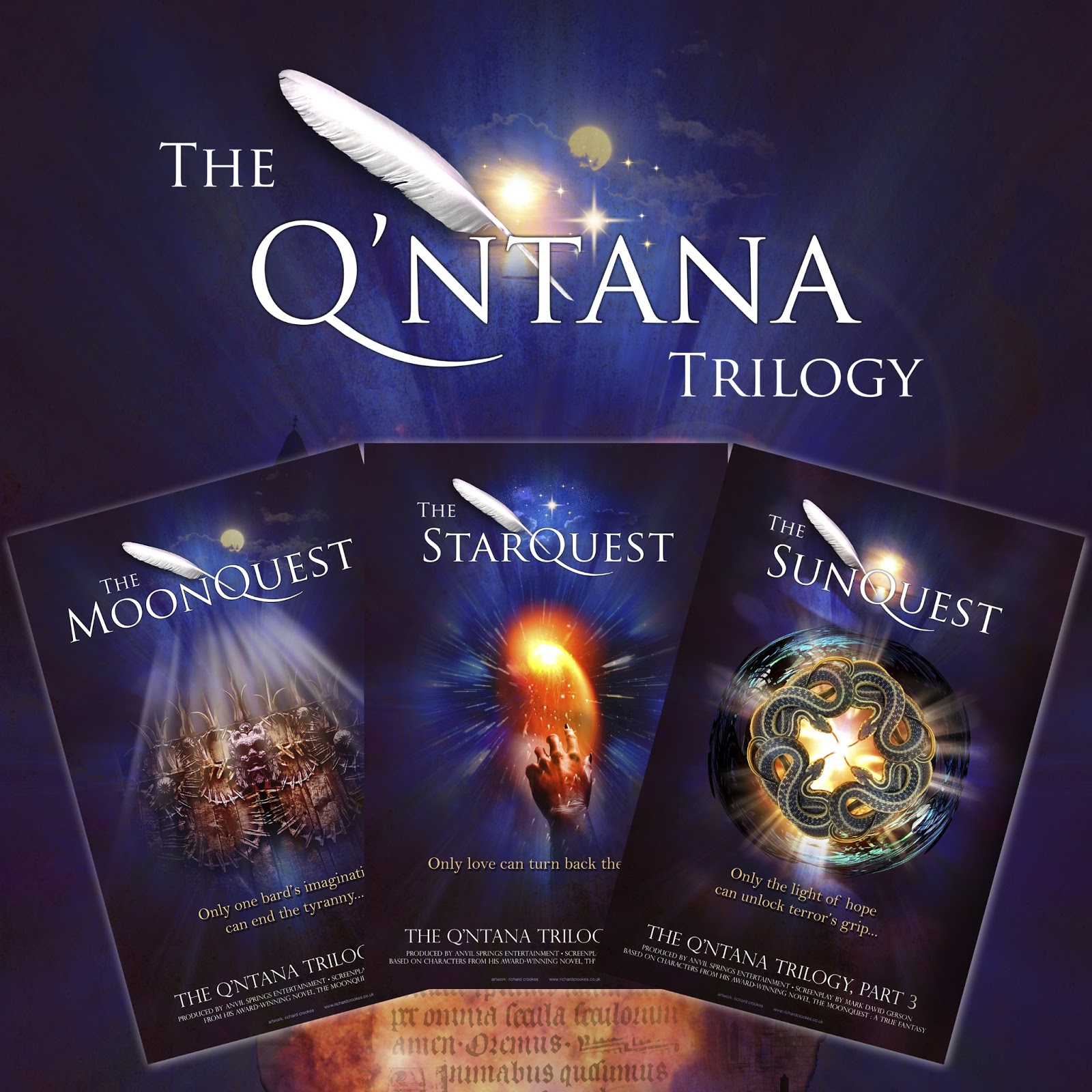
    To help accelerate that process, I'm now working with Anvil Springs to produce three short trailers -- one for The MoonQuest and one for each of its two sequels, The StarQuest and The SunQuest. Together the three stories (book and film) make up The Q'ntana Trilogy.

    The trailers will be presented to investors in the coming months to inspire them to invest in a feature-film version of The MoonQuest, the first of the trilogy to be produced.

    So far, for the trailers, we've assembled a stellar cast of actors, a dedicated crew and a committed production and postproduction staff. Most are local to New Mexico, but some are planning to travel to Albuquerque from Los Angeles next month for the film shoot. One of the many miracles surrounding this project is that everyone involved is not only a professional but a volunteer who believes passionately in the project. They're volunteering because our starting budget for these trailers was $0.

    By the way, miracles have surrounded this project almost since the day the book came out.

    It was at one of my very first book-signings, in an Albuquerque Borders Books & Music, that I met Kathleen Messmer, who had just created Anvil Springs and was on the lookout for new projects. She loved both the book (which hadn't yet won its multiple awards) and my screenplay adaptation, and the rest is history.

    Well, almost...

    Although we began trailer production on a zero budget, we've come to realize that there are some expenses we just can't avoid incurring, not least because New Mexico isn't the best resource for the medieval-style costumes, props and settings required for this type of fantasy.

    That's where you come in.

    Today, we launched a fundraising campaign on Indie GoGo, the web's premier platform for the grassroots financing of independent creative projects. With your help, we can raise not only our $3,000 Indie GoGo goal for The MoonQuest trailer, but an additional $2,000 to make sure that the StarQuest and SunQuest trailers are also filmed -- and that all three are of the superlative quality that will propel their respective features to the big screen.

    To thank you for your contributions as low as five dollars, we're offering a series of gifts, ranging from a public thank you to a day on set during the filming of the trailer. In between, there are opportunities to get MoonQuest merchandise, a studio-photographed headshot, an hour's creativity or life coaching from me...and more. But you can give a gift of any amount -- even one dollar...or less.

    A few hours ago, one of my Facebook friends posted this on my wall:
    "I don't know anyone who is living their dream more than you."
    I feel incredibly blessed to find myself in that place. With your help, I can take that dream to its next level -- not only for myself but for all those who will be touched by the life-affirming message of the Q'ntana stories.

    Please share news about our Indie GoGo campaign and our project wherever you can -- on Facebook, MySpace and Twitter, on blogs and to your friends. The more people who know about the campaign and the project it's supporting, the sooner you'll see The MoonQuest in a movie theatre near you!

    Finally, if you would like to make other types donations (for example, bottled water, snacks, props, wardrobe, etc.) or have skills you can contribute, please write to us at info@anvilspringsentertainment.com.

    • Once again, here's the link to our Indie GoGo campaign.

    Art Credits: MoonQuest movie graphics by Richard Crookes. MoonQuest book cover by Angela Farley.

    Thursday, January 6, 2011

    CREW CALL for "MoonQuest" Movie Trailers

    Anvil Springs Entertainment is currently accepting resumes for ALL CREW POSITIONS for for three feature-film trailers: for The MoonQuest and each of its two sequels, The StarQuest and The SunQuest.

    When completed, the three feature films will comprise Mark David Gerson's Q'ntana Trilogy.


    We will be filming the three feature trailers during two weekends in February in the Albuquerque and/or Santa Fe areas. This will be a non-union, low/no/deferred pay production.

    Please send crew resumes to crew@anvilspringsentertainment.com.
    Please NO PHONE CALLS.

    (Anvil Springs is also holding a January 8 casting call in Albuquerque. Click here for details.)

    For info on Anvil Springs Entertainment visit anvilspringsentertainment.com. (“Like” us on Facebook.)

    Monday, January 3, 2011

    CASTING CALL for "MoonQuest" Movie Trailers

    Anvil Springs Entertainment is holding a second open casting call for speaking and background roles for three feature-film trailers: for The MoonQuest and each of its two sequels, The StarQuest and The SunQuest.

    When completed, the three feature films will comprise Mark David Gerson's Q'ntana Trilogy.


    Casting non-descript / all types; Ages 16+
    (If you're under 18, you need a parent present.)
    Various Speaking Parts Available
    Background needed: Villagers and Soldiers

    When: Saturday, January 8, 2011
    Time: 3pm to 6pm
    Where: Clarion Hotel, 7620 Pan American Fwy. NE, Albuquerque, NM

    *** Please do not call the hotel with questions.

    This is an action-packed, fantasy-themed trilogy: Think of The Chronicles of Narnia meets Lord of the Rings.

    Filming will take place during two weekends in February. This is a non-union, no-pay shoot. However, meals will be provided.

    If you can't make this open casting call, please submit your headshot and resume to: casting@anvilspringsentertainment.com

    *** If you attended the previous casting call or have submitted via email, your information is on file. There is no need to attend this casting call.

    (Anvil Springs is also accepting resumes for all film crew positions. Click here for details.)

    For info on Anvil Springs Entertainment visit anvilspringsentertainment.com. (“Like” us on Facebook.)