Friday, March 1, 2013

Mark David's "Rules" for Living

These so-called rules were for a long time on the home page of my website, inspired by the "rules" for writing I first crafted for my book on writing/creativity, The Voice of the Muse: Answering the Call to Write.

The two sets of "rules" are intentionally similar because I believe that the same precepts that can guide us to more creative, imaginative, expressive, passion-filled and spontaneous writing and artistry apply equally to living a more creative, imaginative, expressive, passion-filled and spontaneous life.

You'll find the newest version in my newest book for writers, Birthing Your Book...Even If You Don't Know What It's About
.
Rule #1
There are no rules: There is no right way. There is no wrong way. There is only your way...the way that works for you.

Rule #2
What works for you today may not work tomorrow, so you might as well live in the present moment.

Rule #3
Listen to your heart and trust it; it speaks with the voice of God (or whatever you call that divine intelligence or infinite mind we all carry).

Rule #4
Be vulnerable: Share your pain and your passion. That's what makes you human.

Rule #5
Treat yourself as you would your child or best friend: with love, compassion and respect.

Rule #6
Don't live your life according to others' expectations...or according to your own preconceptions. Free yourself to follow the path that is uniquely yours, and surrender to its gifts and surprises.

Rule #7
It's not how often you meditate, it's whether you live your life as a meditation.

Rule #8
Giggle. Smile. Dance. Guffaw. Don't take life too seriously. Just as you don't censor your pain (see Rule #4), don't censor your joy.

Rule #9
It's not how hard you push, it's how fully you surrender.

Rule #10
Find your passion and embrace it. Passionately.

Rule #11
It's not about being perfect, it's about being human.

Rule #12
Empower yourself: This is your life. Don't let anyone else tell you how to live it (or not live it).

Rule #13
There are no rules. None. Never.

From Writer's Block Unblocked: 7 Surefire Ways to Free Up Your Writing and Creative FlowBe sure to also check out my "rules" for writing.

• Images: "There Are No Rules" by Wharton; "I Choose Joy" from Teri Wilder's CD of the same name

Please "like" these Facebook pages...
Please follow Mark David on Pinterest and Google+

Tuesday, February 26, 2013

Mark David's "Rules" for Writing

These so-called rules, adapted from the ones I crafted for my book on writing/creativity, The Voice of the Muse: Answering the Call to Write, are intentionally similar to my other set of "rules," for living.

They're similar because I believe that the same precepts that can guide us to more creative, imaginative, expressive, passion-filled and spontaneous writing and artistry apply equally to living a more creative, imaginative, expressive, passion-filled and spontaneous life.


Rule #1
There are no rules: How can there be when creativity is all about breaking new ground and breaking old rules?

Rule #2
Be in the moment: Focus only on the word you're writing. The next one will come if you don't worry about it.

Rule #3
Trust the voice of your Muse without judgment or censorship. It's smarter than you are and knows the story better than you ever will.

Rule #4
Be vulnerable: Write from a place of powerful emotion, especially the one you'd rather not write about.

Rule #5
Love yourself and your words...every draft.

Rule #6
Don't force your words into the straitjacket of your preconceptions and expectations. Free them to take on the form that is theirs.

Rule #7
If you're feeling stuck, keep your pen  moving (or your fingers dancing across your keyboard). Write anything!

Rule #8
Always go with first thoughts. Second-thoughts are self-censoring thoughts.

Rule #9
You're not in charge, so get out of the way and let your story have its way with you.

Rule #10
Write: Commit to yourself as the writer you are.

Rule #11
Set easy goals and meet them. Set yourself up for success not for failure.

Rule #12
Empower yourself: This is your creative journey. Don't let anyone else take charge of it.

Rule #13
There are no rules. None. Never.

From Writer's Block Unblocked: 7 Surefire Ways to Free Up Your Writing & Creative FlowBe sure to also check out my "rules" for living. You'll find a slightly different version of my writing rules in The Voice of the Muse: Answering the Call to Write and on The Voice of the Muse Companion: Guided Meditations for Writers (CD or MP3 download).


Please "like" these Facebook pages...
Please follow Mark David on Pinterest and Google+

Tuesday, February 12, 2013

New Rhythms, New Routines

How I shattered old rhythms and forged new routines to get past some of my creative blocks: An excerpt from The Voice of the Muse: Answering the Call to Write

Because so much of my writing history at the time I created my novel The MoonQuest was linked to desks, deadlines and other people’s projects, the only way I could banish old associations that felt anything but free-flowing was to break all the patterns of my previous writing life.

First I abandoned the computer, composing The MoonQuest’s early drafts with pen and paper. Next, I abandoned my desk, bound as it was to the soul-numbing words that had so recently comprised my freelance-writing livelihood.

Mornings, with a pad balanced on my knee, just before or after breakfast, I allowed The MoonQuest’s scenes to pour from my pen onto the blank page. Evenings, I input the day’s jottings into the computer.

Some days I needed a more dramatic break from the old to connect with my nascent story. On those days I often drove over North Mountain to Baxter Harbour on the Bay of Fundy. There, as the Atlantic surf crashed on the rocky Nova Scotia shore, I sat in the car or on a boulder and let the ocean tell me what to write next. A one-day change of habit and venue was all it took to put me back on track.

Here’s a suggestion:
When you feel blocked, break the pattern of your normal routine. If you normally write on the computer, switch to pen and paper. Write in the morning instead of the afternoon or evening, or vice versa. If you tend to write at your desk, move away from the perceived pressures of your "work" environment. Go for a walk to clear your mind. Take pad and pen and curl up in a comfortable chair. Sit out in nature. Move to a favorite café. Drive to some place quiet...different...inspirational. And feel the creative power of your new rhythm.

Adapted from The Voice of the Muse: Answering the Call to Write (c) Mark David Gerson
• For more Voice of the Muse excerpts, visit the book's website or Facebook page
• Get your copy of The Voice of the Muse and The MoonQuest today: in paperback at Amazon.com or as an ebook for Kindle, Nook, iBook or Kobo apps and readers

Photo: Baxter Harbour, Nova Scotia. Photographer Unknown

Please "like" these Facebook pages...
Please follow Mark David on Pinterest and Google+

Thursday, February 7, 2013

Why Are Americans Afraid of Dragons?


It's December 2008 and I'm in the video section of Target, Christmas shopping for my daughter. As I'm browsing through the movie racks, I overhear an older and younger woman discussing which DVD to buy a child on their list.

"What about Eragon?" the younger woman asks. "I hear it's good."

"Does it have magic in it? I don't want a movie with magic," the older one -- her mother? -- responds sternly.

They move out of earshot and I'm too stunned to follow.

Are we truly living in some version of The MoonQuest's mythical setting? This land where vision is outlawed and visionaries put to death, where myth and magic are forbidden, where "once upon a time" is a forbidden phrase, and where fact is the only legal tender was a creation of my imagination... Or was it?

What kind of culture have we created where children are denied magic, where fantasy is suspect and where dragons are relegated to dustbins?

Thirty years ago in an essay, author Ursula K. Le Guin asked, "Why are Americans afraid of dragons?" She concluded that most technological cultures dismiss works of the imagination because they lack measurable utility, an outlook only exacerbated in this country by our Puritan heritage.

If 30 years ago dragons were not fit for adults, are they now unfit for children, too?

While the Harry Potter books and movies broadened the reach of imaginative fiction for kids (and adults), it also expanded our hysterical suspicion and suppression of it.

The fact is, imaginative fiction opens our hearts, expands our spirit and broadens our minds in ways that nonfiction never can, and that magical/fantastical fiction can carry more truth in its castles, dragons and trolls than many pieces of so-called literature.

That's why I call The MoonQuest a "true fantasy." There is nothing factual about it. But as those two women in Target have proven, it's decidedly true.

This piece originally appeared in December 2008 on my now-dormant New Earth Chronicles blog.

Please "like" these Facebook pages...
Please follow Mark David on Pinterest and Google+

Sunday, February 3, 2013

Death to the Ego? Not!

"Despise Fvorag and you despise a part of yourself. For we are all One in Prithi."
— The MoonQuest: A True Fantasy


"Death to the Ego!" I've heard that war cry, so common in personal-growth circles, several times in recent days. And each time, it left me profoundly saddened.

You see, the oft-demonized ego doesn't deserve to die. No part of us deserves to die.

No part of us deserves to be dismissed...or dissed. All parts of us have value. All parts of us have worth. All parts of us are capable of growth and transformation. Of redemption.

Many writers and therapists would have you believe that the ego is some inner evil that must be cut off, stamped out and killed before we can move forward.

"Ego," I read the other day, "is the biggest — and perhaps the only — obstacle to true enlightenment. If we want to be free, if we want to be enlightened, we have to pay the price: death of the ego."

Not only is that view wrong-headed, it is damaging.

Certainly, the ego or "small self" can stand in the way of our evolution. Yet whatever else it is or does, it is still a part of our greater self, of our oneness. Of God.

God, however you define it, is made up of all the pieces of us — dark and light, evolved and not. God is not just the pieces we like or would prefer.

When we use phrases like "death of the ego," we're advocating an act of self-hatred and self-destruction that is not at all godlike.

How can we call for oneness in one breath and the destruction of a part of ourselves in the next? How can we preach love as the energy that creates and heals all when, in the same sentence, we preach hatred toward parts of ourselves?

If your arm is broken, do you cut it off because it's now a useless appendage? Or do you allow it to heal, lavishing extra love and energy upon it because of its weakened condition?

The ego is no less deserving of care and no less capable of healing and transformation.

I passionately believe that we are called to love, honor and respect all aspects of our beingness, not just the ones that behave in right/light ways.

We live in a throwaway culture, tossing out anything that's broken, a culture where imperfection is punished and misbehavior condemned. What have we become that we are now throwing away bits of ourselves?

The ego is nothing more than a terrified, lesser-developed aspect of ourselves, a child-aspect that feels threatened by change it does not understand and so resists, often disruptively.

In many ways, it's like a fearful child. We don't kill our children when they don't act in a divine manner, when they're frightened and act out. We reassure them, we hold them, we love them. We make sure they know that they're safe.

Through these compassionate, godlike acts, we gently correct their failings and contribute to their growth and evolution, and to our own.

Our call is to do the same with the ego. Speaking of killing, expelling, conquering or controlling it is the antithesis of the evolved energy we claim we are seeking to embody.

Some might respond by saying that these are only words, that nothing is really being killed.

Perhaps. But language is not random. We choose our words, and these words reveal more about what we think and feel than we often realize. If we use words like "death" and "killing," than that truly is the consciousness we are projecting.

Oneness, too, is a consciousness, one that cannot thrive outside of us if it doesn't first thrive within. And it cannot thrive within if we reject even a single part of ourselves.

Oneness is an act of integration. Preaching death to the ego is the opposite: dis-integration.

The only path to enlightenment is the path of love. And the only path of love that has any value is the path that begins with self-love, with the love of our entire self — the wounded as well as the healed, the frightened as well as the fearless, the dark as well as the light.

Loving it doesn't free it to be in charge or hold us back. It does free it to have a voice, to express its fears, to cry for help in the only ways it knows how.

That same love frees you to embrace every part of you, to welcome home the ugly, wounded, frightened prodigal-child/ego and to live the fullness of a divinity and godliness that includes all aspects of your beingness.

I believe in you, in every part of you, and I love your darkness as well as your light. Won't you do the same for yourself?

• This piece originally appeared in my now-dormant New Earth Chronicles blog. Unfortunately, it remains as relevant today as it was a few years ago, when I first wrote it.

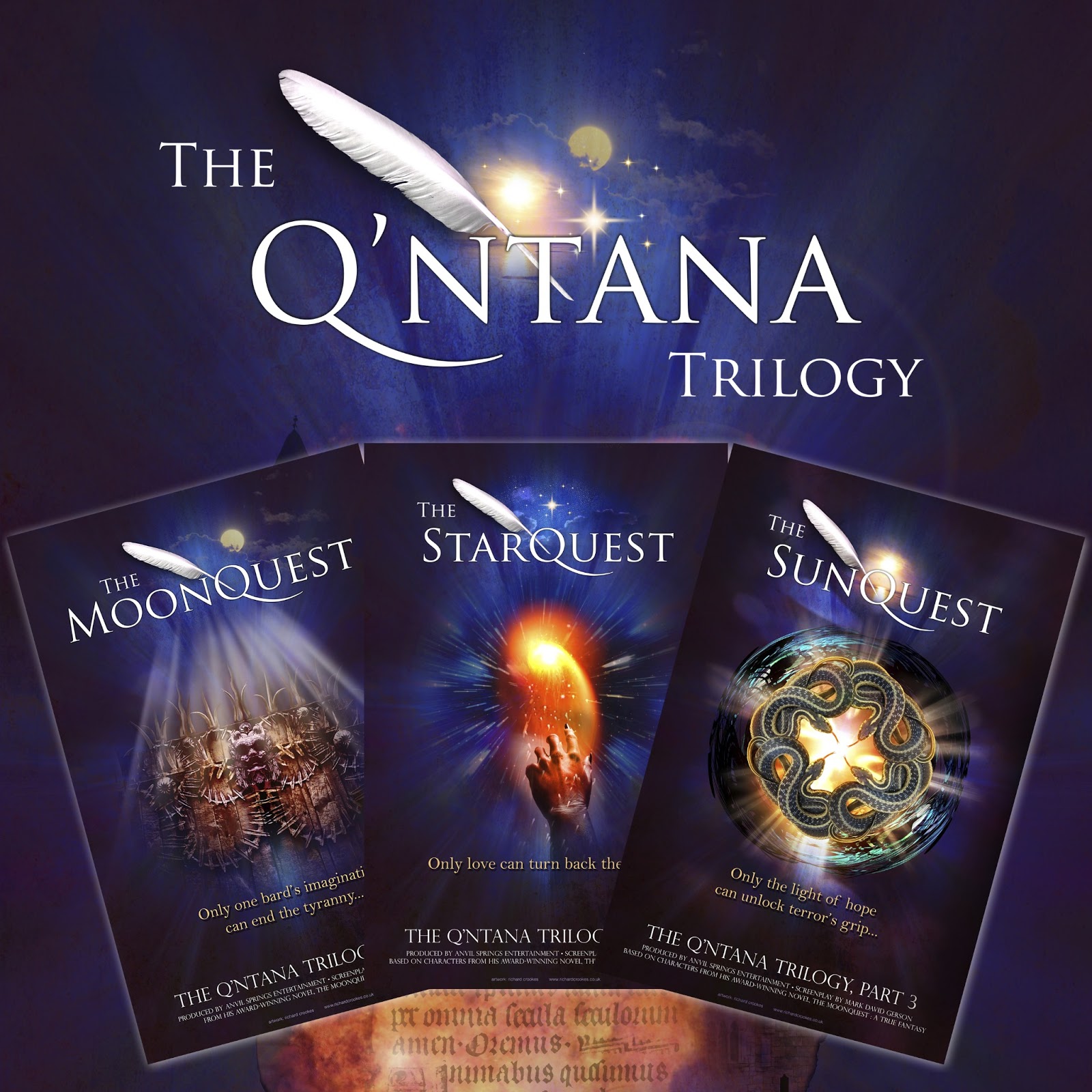
Image: Detail from the cover of The MoonQuest (The Q'ntana Trilogy, Part 1) by Mark David Gerson


Please "like" these Facebook pages:
Please follow Mark David on Pinterest and Google+

Sunday, January 27, 2013

The Word, According to Humpty Dumpty

In the beginning was The Word, and The Word was with Humpty Dumpty...

"When I use a word," Humpty Dumpty said, in a rather scornful tone, "it means just what I choose it to mean — neither more nor less."

"The question is," said Alice, "whether you can make words mean so many different things."

"The question is," said Humpty Dumpty, "which is to be master -- that’s all."

Alice was too puzzled to say anything; so after a minute, Humpty Dumpty began again.

"They’ve a temper, some of them -- particularly verbs: they're the proudest -- adjectives you can do anything with, but not verbs -- however, I can manage the whole lot of them! Impenetrability! That’s what I say!"

"Would you tell me, please," said Alice, "what that means?"

"Now you talk like a reasonable child," said Humpty Dumpty, looking very much pleased. "I meant by 'impenetrability' that we’ve had enough of that subject and it would be just as well if you'd mention what you mean to do next, as I suppose you don’t mean to stop here all the rest of your life."

"That’s a great deal to make one word mean," Alice said in a thoughtful tone.

"When I make a word do a lot of work like that, said Humpty Dumpty, "I always pay it extra."

Lewis CarrollThrough the Looking Glass, and What Alice Found There. Lewis Carroll was born on this day (January 27) in 1832.

What's your relationship with words? Do you take charge of them, as Humpty Dumpty claims to have done? Or do you trust in their innate wisdom?

It wasn't so much over the words themselves that Humpty Dumpty claimed mastery. It was over rigid definitions. Are you a slave to those definitions? Or are you willing to free yourself to be as creatively playful as was Lewis Carroll?


Whichever, you'll find 50 words and phrases to jump-start your writing and play with on page 40 of The Voice of the Muse: Answering the Call to Write, available at Amazon.com and as an ebook for Kindle, Nook, iBooks and Kobo readers and apps.

Please "like" these Facebook pages:
Please follow Mark David on Pinterest and Google+

Friday, January 25, 2013

Start Writing...Now!

Don't turn the page.
Stop reading.
Pick up your pen or touch your fingers to the keyboard.
Start writing. 
Now.


Available in paperback at Amazon.comor as an ebook for Kindle, Nook, Kobo and iBooks apps and readers


Please "like" these Facebook pages:
Please follow Mark David on Pinterest and Google+

Tuesday, January 8, 2013

The Path That Is Yours Alone to Travel

There's nothing wrong with formal training and credentials. At the same time (unless you're planning a career in brain surgery), they're not always necessary. If you do your homework (inner and outer) commit to your passion, surrender to its demands and find the heart-centered discipline that keeps you moving forward, you will discover gifts, talents and resources (inner and outer) that you never suspected were available to you.

Take my situation: Nothing I have ever done and succeeded at (and made money at) have I gone into with any formal experience or training. In most cases, I didn't even know that were passions until they came knocking at my door!

In conventional terms, I knew nothing about novel-writing when I wrote The MoonQuest, my first novel (now an award-winner), nothing about memoir-writing when I wrote Acts of Surrender: A Writer's Memoir and nothing about screenwriting when I wrote my first screenplay, an adaptation of The MoonQuest, which is in early preproduction as part of The Q'ntana Trilogy Movies.

I have no art training, yet have sold my drawings. I have no photography training, yet two of my photos were published in Toronto's The Globe and Mail newspaper, and I have sold several others. I have no formal training to teach, coach or speak, yet have been in demand in all three areas and wrote an award-winning book on writing and creativity, The Voice of the Muse: Answering the Call to Write.

Now, I'm launching into the daunting world of filmmaking as director of an epic fantasy trilogy with no directing experience. Am I scared? Absolutely. Will I let my fear get in the way? No way! I spent too many years letting my terror hold me back to relapse into that old pattern.

Bottom line: You do what you feel called to do, you move forward as honestly and confidently as you can, and you know that if you have been called to the task, you have all the support you need. Whatever your passion is, forge ahead....on the path that is yours alone to travel!

• Photo: "The Path" (c) +Mark David Gerson

Please "like" these Facebook pages:

• Acts of Surrender Book

Please follow me on Pinterest and Google+

Thursday, November 29, 2012

Feeling Rejected? Don't Be Dejected!

Remembering author Madeleine L'Engle, born this day in 1918... 

Through both her fiction (ie, A Wrinkle in Time) and non-fiction (memoirs and books about spirituality/writing) author Madeleine L'Engle has long been a major influence in my life. I didn't discover A Wrinkle in Time until I was an adult in the early years of my spiritual awakening. But when I did, I found it to be a gem of a book, filled -- as is all L'Engle's writing -- with spiritual truths for young adults and adults alike. Today, two decades after that first reading, the profound wisdom of this prolific author and devout Episcopalian continues to inspire me.

One of my favorite L'Engle stories, apart from the one that follows, comes from one of her nonfiction books -- I don't now remember which. In it she describes legions of white-bearded Old Testament prophets, their faces raised to the sky, shouting up at God, incredulously: "You want me to do what!?" There are still days when I know just how they felt!

It would have been a supreme privilege to have able to meet Madeleine L'Engle, but she died in 2007, before I had the opportunity. To mark her birth and celebrate her life, I am reprinting this, one of my most popular blog posts.

Feeling rejected? When you read L'Engle's story, I guarantee you won't be dejected!


Author Madeleine L'Engle received two years' worth of rejections from 26 publishers for her novel A Wrinkle in Time, which, once it was finally published in 1962, went on to win major awards and be translated into more than a dozen languages.

Toward the end of that two-year period, L'Engle covered up her typewriter and decided to give up -- on A Wrinkle in Time and on writing. Then on her way downstairs to the kitchen, a revelation: an idea for a novel about failure. In a flash, she was back at the typewriter.

"That night," as she explained in April 1993 on the PBS documentary Madeleine L'Engle: Stargazer, "I wrote in my journal, 'I'm a writer. That's who I am. That's what I am. That's what I have to do -- even if I'm never, ever published again.' And I had to take seriously the fact that I might never, ever be published again. ... It's easy to say I'm a writer now, but I said it when it was hard to say. And I meant it."

Today, the bibliography on L'Engle's web site lists 62 works spanning the period from 1944 through 2005, plus a 63rd, published posthumously in 2008. Sadly, Madeleine L'Engle died in September 2007.

"I cannot possibly tell you how I came to write A Wrinkle in Time," her New York Times obituary quotes her as having said. "It was simply a book I had to write. I had no choice."


Whether you're published or not, if you're writing, you are a writer.

Need some help believing that? watch the video meditation, "You Are A Writer." The audio was drawn from The Voice of the Muse Companion: Guided Meditations for Writers.


Tuesday, November 27, 2012

Email Address Changes...

I'm in the midst of rationalizing and reconfiguring my email addresses, both business and personal, and some existing addresses for me will soon disappear. If you're getting this post in your email, then you're on my mailing list and, if I did it right, you'll see my new contact address on the "from" line of this mailing. 

If you're not yet on my list, head over to www.markdavidgerson.com; there's a subscription blank at the bottom of every page. There's also one in the sidebar of this blog.

As always, I look forward to hearing from you!

Please "like" my Facebook pages:

• Acts of Surrender Book

Please follow me on Pinterest