Tuesday, April 24, 2012

The Unexpected Joys of Authorship


Being an author comes with many rewards. The first, of course, involve the joy of creation and the sense of accomplishment when the final period drops onto the final sentence of the final draft...often years after the first word of the first draft found its way onto the blank page. 

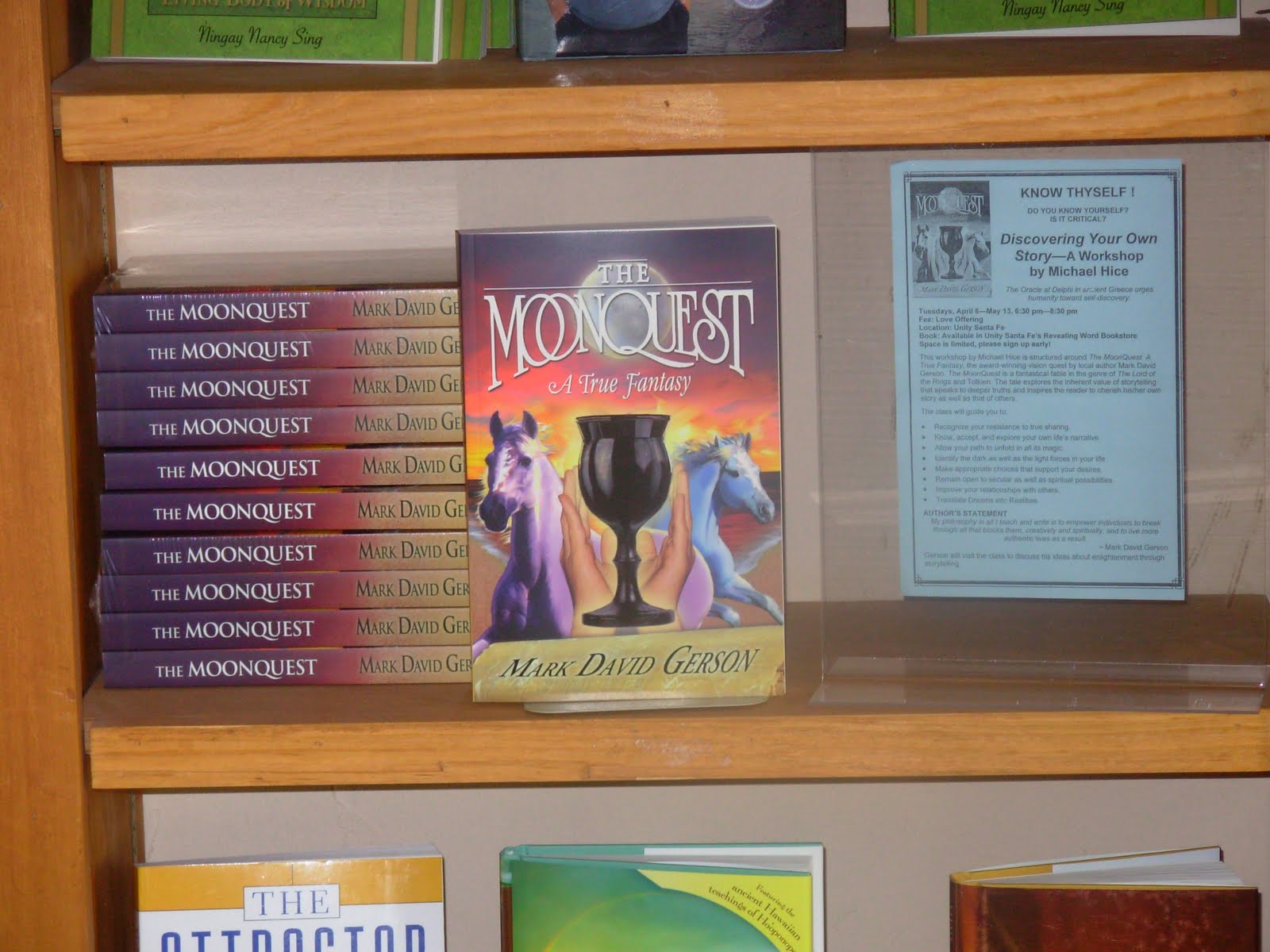
As miraculous as that instant of completion felt for me with The MoonQuest, another moment was more powerful still: when I ripped open the FedEx envelope that held my advance copy of the published book, my first. Thirteen years, two months and a few weeks after the beginnings of a story I knew nothing about had pressed themselves into my consciousness, I cradled the results in my hand and wept. Only the birth of my daughter eight years earlier surpassed the emotion and exultation of that experience.

As the weeks, months and years passed, first the The MoonQuest and then my second book, The Voice of the Muse: Answering the Call to Write, offered up many more occasions for joyful tears: multiple awards, glowing reviews, enthusiastic reader response and, of course, a movie deal encompassing not only The MoonQuest but its two Q'ntana Trilogy sequels. 

While neither book is yet a runaway bestseller, both The MoonQuest and The Voice of the Muse have attracted intensely loyal readers who have never hesitated to share with me all the ways that my books have deeply moved them and profoundly transformed their lives. In turn, their comments have deeply moved me and, in some cases, transformed my life. 

I can't speak for all creative artists, but this one still carries some core insecurities about his abilities and his work. It's not always easy for me to grasp how much my books are loved...and reread. As gratified as I am by the praise, I am sometimes equally baffled. "Me?" part of me still asks. "How?"

Thankfully, I have grown past the phase when I worried that perhaps I was a fraud. Still, when circumstances prompted me to reread the opening 40 pages of The MoonQuest a few weeks back, for the first time since proofreading its galleys five years ago, not only was I startled by how good it was, I was startled by how startled I was! Perhaps it has taken five years' distance to begin to be able to read those words as others read them.

Or, perhaps I'm not quite there yet. 

Last night, I received an email from singer/songwriter Amy Robbins-Wilson inviting me check out a video she had just recorded and asking my permission to release it publicly. Inspired by a scene in The MoonQuest, she had written and performed "Eulisha's Song," a stirring, evocative prelude to the journey that Eulisha's grandson, Toshar, would be called to undertake in the book.

Toshar, Amy explains, has just retired to his room after Eulisha urges him to embark on The MoonQuest. "I wondered," she says, "'What would Eulisha do while he slept?' It felt like she would sing and pray and send her power forward into the darkness to light his way."

I watched and listened to Amy's creation in rapt astonishment — not only because of the content of the song and by her haunting rendition, but because of the fact of the song. Although many, as I noted earlier, have shared with me their passion for The MoonQuest, this is the first time, to my knowledge, that any of that passion has inspired a work of art separate from me. 
"I started work on the song a couple months ago," Amy says, "and it all came together in a long car ride where I had to pull over at least three times to write down what I was singing. There are so many songs to be written for The MoonQuest."
So many songs...so much inspiration... For me...from me. Perhaps that's the ultimate reward of authorship: knowing that even as I have moved on to other stories, this one lives on --  not only inspiring others but also inspiring new creations in a never ending cycle of creativity. What could be a better life for a story that, at its root, is about the rekindling of blocked expression. And what could be a better gift for its author. Thank you, Amy. • Purchase The MoonQuest on my website or Amazon • MoonQuest ebooks for Kindle, iBook, Nook or Kobo • Candle photo: rgbstock.  • Direct YouTube link to Amy's video Please "like" my Facebook pages: • Acts of Surrender book • The Q'ntana Trilogy Movies • The MoonQuest book • The Voice of the Muse book • Mark David Gerson

Sunday, April 1, 2012

The Power of Your Pen

Pick up your pen and hold it in your hand. Feel its weight and texture. Study its form and aspect. Sense its potential.

Can you see or imagine the ink that sloshes around in the barrel as you move it this way and that? Can you visualize the waves that crash from one shore to the next — waves of blue or black or, if you’re more fanciful in your implements, magenta or fuchsia?

Your words bob up and down in that sea of ink, in that ocean of story that ebbs and flows from barrel to nib to page.

Don’t push your pen as you set it down on the pristine whiteness of the virginal page. Follow it. Allow it to carry you on a wondrous journey as you surrender to it and allow it to chart the course of your creativity.

Follow your pen. Let it guide you on a safari into the darkest of Amazon jungles, the uncharted territory of your deepest self.

Your pen will map out the journey, inking your itinerary as it forms before your eyes, allowing you and your readers the freshness of new experience.

Follow your pen, as I do at this moment, not knowing where it will carry me, allowing my terror to exist side-by-side with my awe and wonder, each word emerging despite my resistance to it.

I, too, fear the unknown, despair at the necessary surrender. I, too, long to know how this sentence will end and who I will be when it does.

I cannot know...need not know...at times dare not know.

All any of us can do who are called to this journey is place one word after the next and then another and then another, allowing the power of our pen — or of our fingers skipping across the keyboard — to chart the way, pen stroke by pen stroke, pixel by pixel, moment by moment, breath by breath.

~ excerpted from The Voice of the Muse: Answering the Call to Write by Mark David Gerson (c) 2008

For additional tips and inspiration, pick up a copy of The Voice of the Muse: Answering the Call to Write and The Voice of the Muse Companion CD from my online bookstore, and be sure to ask for a signed copy of the book. Both are also sold on Amazon

The ebook is available for Kindle, Nook, iBook and Kobo. Download an MP3 version of the CD at CD Baby, iTunes and Amazon

Fountain pen images: #1 unknown; #2 Athena www.bit.ly/Hxv2Cd


Please "like" my Facebook pages:

Wednesday, March 28, 2012

The Magic of Story


Without the magic of writing, the magic of reading could not exist.

If you have a story in you (and who doesn't?), now is the time to listen to its call and start freeing it onto the page.

You're not sure how? Start with one word, any word. Then, surrendering yourself unconditionally to your story, add another and another. And then another. Don't think about what the story is or where it's taking you. Don't struggle for the right word, right character or right plot. Just start, follow that free-flowing river of creativity I call your Muse Stream and trust in the journey...the journey beyond your imagination.

Need some help launching your story or keeping the momentum going? The Voice of the Muse: Answering the Call to Write can help -- with inspiration, tools, techniques and exercises to get you writing and keep you writing.

And whether you're writing or not, it's always a good time to pick up a book and dive into the storytelling world of its author.

Original photo at Bookshelf Porn

Please "like" these Facebook pages...
• The Voice of the Muse book
• The MoonQuest movie
• The MoonQuest book
• Mark David Gerson

Tuesday, March 20, 2012

Maya Angelou: The Call to Write

"There is no greater agony than bearing an untold story inside you."
~  Maya Angelou

What stories are you carrying inside you that are yearning to be freed onto the page?

What stories are you carrying inside that, once freed onto the page, will also free you?

Whatever they are, write one of them. Now.

Write your story, and feel the healing freedom that all creative acts inspire.

• For more writing inspiration, go to www.calltowrite.com for excerpts from The Voice of the Muse: Answering the Call to Write


Photo: Dwight Carter www.mayaangelou.com

Please "like" my Facebook pages:
• The MoonQuest movie
• The MoonQuest book
• The Voice of the Muse book
• Mark David Gerson

Friday, March 16, 2012

Have You Heard the Call? ... The Call to Write?

Have you heard the call? 
The call that thrills as it terrifies you?
The call to set something down on paper? 
The call to inspire others...in ways you do not yet understand? 
The call to write? ...
~ author Mark David Gerson reads "Have you Heard the Call" from The Voice of the Muse: Answering the Call to Write.


• To view the video on YouTube, click here.

• For more videos about writing and the creative process, visit my YouTube page.

• You'll find additional tips and inspiration on my web site, where you can read my "Rules for Writing," join my mailing list and read/hear free excerpts from The Voice of the Muse: Answering the Call to Write.

Buy The Voice of the Muse: Answering the Call to Write and The Voice of the Muse Companion: Guided Meditations for Writers from my online bookstore, and be sure to ask for a signed copy of the book. Both are also available on Amazon

Please "like" my Facebook pages:
• The MoonQuest movie
• The MoonQuest book
• The Voice of the Muse book
• Mark David Gerson

Monday, March 12, 2012

The Story Knows Best II

Earlier today, I offered these thoughts in response to a writer's request for feedback on a memoir piece he had written. 

With his permission, I offer a slightly edited version here, as it is the foundation of everything I believe about writing and the creative process. 

It's a philosophy I express often on these pages and in the pages of The Voice of the Muse: Answering the Call to Write: "The story (whatever it is) is smarter than I am. It always knows best."

"Here's my general guidance that, I trust, will speak to your specific questions. From what I know of you through your writing and from what I sense and intuit of you through your spirit, I'm certain that it will resonate with you...

"Your story (be it a few pages or a few hundred) is its own sentient entity and its own presence. As a memoir, it may appear on the surface to be about you, which perhaps gives you the illusion that you know what it is about. However, you are simply the raw material for a story that knows far more about what it is about than you ever will.

"From that place, I urge you to listen to the story that moves through you onto the page as closely as you have come to listen to your heart, to surrender to it as completely as you are learning to surrender to your heart, and to trust it as fully as you know you must trust your heart.

"As you are able to do those things, you will honor the heart that is singing to you and the heart of the story that is singing through it to you. And when you are done your two pages or two hundred, you will be amazed and astounded at what has been crafted through you and how you have been crafted because of it.

"I have every confidence that you can open yourself to that and every confidence, as well, that what will emerge will transform you (and others) in ways that you cannot not imagine."

Photos by Mark David Gerson: #1 Story, AK; #2 Christmas butterfly

Please "like" my Facebook pages:
• The MoonQuest movie
• The MoonQuest book
• The Voice of the Muse book
• Mark David Gerson

Thursday, March 1, 2012

Mark David Gerson: A Writer's Life II

This is an updated version of an interview that appeared last month at Writers Unite, an international online writers' community out of the U.K. 


Writers Unite: Firstly, congratulations on your trilogy becoming a movie! Can you tell us about your Q'ntana Trilogy novels?

Mark David Gerson: Thanks. The Q’ntana Trilogy books consists of The MoonQuest, The StarQuest and The SunQuest. The MoonQuest takes place in Q’ntana, where stories have been banned and storytellers put to death and where the moon, saddened by the silence, has cried tears that have extinguished her light. The quest is to restore story to the land and light to the moon. Because The StarQuest and SunQuest are still in process, I’m not prepared to reveal their plots, other than to say that the evil force behind the tyranny in The MoonQuest spans all three books.


WU: Did you have any goals for this collection when you wrote it — to get published, or just to finish, etc.?

MDG: I have to give you some background before I answer the question. When I began The MoonQuest (or, rather, when The MoonQuest began me), I had no plans for a trilogy, nor did I even have a conscious desire to write a fantasy novel. In fact, I knew nothing about the story, including its title, when the first words found their way out of me onto the page. I tell a longer version of the story on my blog. In short, though, The MoonQuest birthed itself during a Toronto writing workshop I was facilitating when, in an unprecedented in-the-moment inspiration, I did the same exercise I had just presented to participants. What I wrote that evening became the opening scene of the first draft of a novel I knew nothing about. From there, I just kept writing, discovering the story as I went along, until I was done. The StarQuest and SunQuest stories emerged similarly.

I don’t remember now when I knew this would be a trilogy, but I suspect it wasn’t until after I had written The MoonQuest’s second draft. At that point, I knew the titles of the two subsequent books. But I had not the remotest idea what they would be about. As it turns out, Q’ntana (named after the land in which the stories are set) is not a traditional trilogy given that, for the most part, each story focuses on different characters. It’s more a time-bending generational epic, with The StarQuest featuring the daughter of The MoonQuest’s protagonist and The SunQuest featuring her son, although, I said above, the evil Bo'Rà K'n character is present in all three books.

As for goals, I would be lying if I said I didn’t care whether or not the books would be published and movies produce. But the truth is that I had to write them, regardless of outcomes or consequences. I had no more choice on my journey than did Toshar, The MoonQuest’s protagonist, on his.


WU: How long did the novels take you to write?

MDG: Not only did I write each novel differently, each took a different length of time to complete.

It took me six months over the course of a year to write the first draft The MoonQuest: two three-month segments of writing broken up by six months when I didn’t work on the book at all. In one of those curious synchronicities that seems to follow me around, I finished the first draft a year to the day after that Toronto writing workshop mentioned above. Although early drafts were completed in the mid- to late 1990s, the book didn't come out until 2007.

In some ways, The StarQuest was the most challenging of the three. Believing (erroneously) that I was finished with The MoonQuest, I began The StarQuest in April 1998. After two aborted attempts to complete a first draft, spread out over a decade, I finally started a new first draft in late 2008 and finished it in July 2009. Last month  (February 2012), I completed what I believe to be a publisher-ready draft of the book and a production-ready draft of the screenplay.

Two things set the trilogy's third story, The SunQuest, apart. The first is that I wrote the screenplay before tackling the novel. With The MoonQuest, I sourced my screenplay adaptation from a largely complete book manuscript. For The StarQuest screenplay, I used that finally completed, ultra-chaotic first draft as my foundation. I decided to challenge myself with The SunQuest by beginning with the screenplay. Once that was done, I wrote a first draft of the novel in what for me was a record-breaking three weeks! 


WU: How long have you been writing?

MDG: Perhaps the better question would be, "How long did you resist writing?" I often joke that my Muse tricked me into writing, given that for most of my early life, I resisted anything remotely creative. My first jobs out of university were in public relations, where I had to write, even if what I initially wrote was largely formulaic. However, that experience gave me the confidence to try my hand at freelance work and, before I knew it, I was a full-time (self-taught) freelance writer and editor, doing mostly magazine, newspaper, corporate and government work. It wasn’t until my early 30s, when the double-whammy of a creative and spiritual awakening whacked me over the head, that I began to explore more creative avenues. And it wasn’t until I was 39 that The MoonQuest, my first foray into serious creative writing, began to have its way with me. I’ve been hooked ever since. 


WU: Did you outline, and if so, how does it help you? 

MDG: Apparently, I’m congenitally unable to outline. Even when I was in high school and was required to turn in an outline with my essay, I always wrote the essay first. I then crafted the outline.

When I begin a project, I rarely know the story in advance. So far, the closest thing I’ve come to an outline was having The SunQuest screenplay in front of me when I wrote the novel. But there was no outline for the screenplay!

When I began The MoonQuest, as I said earlier, I knew nothing about the story, except what emerged in each day’s writing. I didn’t have a title until about halfway through and I had no idea of the ending until about two-thirds of the way through. It was an experience in surrender: in surrendering unconditional control to my Muse and to the story. And it was tough! It was tough to keep writing with no plot, no outline and not even the remotest clue where the story was taking me. But it taught me how to get out of the way and let the story have its way with me. That’s still how I write -- regardless of the form, genre or project. Fortunately, I now do it with much less resistance than I did it on The MoonQuest. But it’s still, sometimes, the most challenging aspect of the work...even as it’s also the most exhilarating and is, for me, the key to the magic!


WU: What was your writing routine for the novels?

MDG: One of my so-called "rules” for writing, abridged on my website from my book on writing, The Voice of the Muse: Answering the Call to Write, is that there are no rules, that what works today may not work tomorrow. From that place, I have no strict routine that I have carried through from project to project.

With the first draft of The MoonQuest, I was so stressed by this notion of surrendering to the story (despite the fact that I had been teaching that philosophy for a few years in workshops!), that I nearly always wrote first thing in the morning, often before getting out of bed. If I wrote first thing, I didn’t spend the rest of the day stressing about writing!

I wrote large chunks of The Voice of the Muse: Answering the Call to Write longhand, in the car...although, to be accurate, I didn’t know at the time that I was writing a book. I thought I was writing stream-of-consciousness, self-inspiration at a time when I was once again stuck on The StarQuest. A few years later, those scribblings would form the basis of The Voice of the Muse book and its companion CD, The Voice of the Muse Companion: Guided Meditations for Writers.

When, in 2008, I began the third version of my first draft of The StarQuest, I was in a unpleasant, time-consuming job. On one hand, I had no time or energy for much other than work. On the other, I knew that writing was my only key to mental and spiritual health. I considered all the oft-written-about options for the time-challenged (writing late into the night, getting up at 4 a.m., etc.) and dismissed them all as, for me, unsustainable. In the end, I chose to set my alarm for a wake-up call 15 minutes earlier than needed and spent those 15 minutes, still in bed, working on  The StarQuest. Some days I wrote a sentence, some days I wrote a paragraph. But I wrote every day. Not only did it keep me sane but when, a few months later, the job ended, the momentum I had achieved with my 15-minutes-a-day routine carried me through to completion. I finished the draft five months later.

With The SunQuest, I felt so driven that I wrote all day every day, six or seven days a week, during the three weeks it took me to complete that first draft. It was November (2011), so I used NaNoWriMo to help motivate me.

A few days after that SunQuest draft was finished, I returned to a memoir manuscript (Acts of Surrender) and, apparently still in that passionate/obsessive flow, finished that first draft, too...also in three weeks.


WU: Has your life changed in anyway since writing the novels?

MDG: That’s a hard question to answer. Nothing about my life is constant. Everything is in unending transition and transformation. While writing is very much a part of that, I’m not sure I can attach particular changes to particular writing projects. I can say, though, that writing The MoonQuest in that day-to-day, in-the-moment fashion freed me to live my life more in that way. Without The MoonQuest, for example, I probably wouldn't now be living in the U.S. I certainly wouldn't be a father. 


WU: How much of the book is realistic?

MDG: The MoonQuest is subtitled "a true fantasy,” but not because it’s conventionally realistic. Set in a mythical time and place, and in a land with two suns and a hidden moon, it can hardly be said to be an accurate representation of any real place.

The architect Frank Lloyd Wright once said that "the truth is more important than facts” and I wholeheartedly agree with that. For me, the notion of "true fantasy” is about the concept of fiction speaking to deeper truths than fact ever can. Although The MoonQuest is not an objectively true story, it is a story about larger truths.

In one sense, there is no such thing as objective fact. Even history -- supposedly a delineation of facts -- is always colored by those who put it forth. You know the saying, "history is always written by the winners.” Even something as apparently factual as your birthday falls on different days depending on which calendar calculates it (ie, Gregorian, Jewish, Muslim, Chinese, Julian, etc.).

However, the human heart at its deepest levels always speaks truth. That’s where our most powerful stories come from. That’s where our truth resides.


WU: What is the message in your book?

MDG: I don’t believe in consciously writing "message books"...even though I have an ebook titled The Book of Messages! Not only did I not know the story as I was writing the three books in The Q’ntana Trilogy, I was also unconscious of their themes. Yet, the themes are there...for in surrendering to the superior wisdom of the books, I freed the stories to delineate and illuminate their own themes, without any interference from me. The obvious themes in The MoonQuest involve censorship, including self-censorship, freedom of expression, transcending creative blocks, and surrender...the same type of surrender I used in getting the book onto the page. Again, I knew none of that during the writing and, I believe, that that’s just as well. By letting the themes emerge as organically as the story did, they are (I hope) not at all heavy-handed and integrate well with the plot.

But there are other themes as well, ones readers discover and share that I knew nothing about. Those are the most exciting for me, as they reveal the book as a living organism that exists independent of me.


WU: What are your readers’ reactions to it?

MDG: Although winning awards and getting great reviews for both The MoonQuest and The Voice of the Muse have been tremendously gratifying and validating, and although having a producer primed to turn the trilogy into a series of feature films is fabulously exciting, what’s most rewarding is when individual readers tell me how one or both of my books has affected them and, in some cases, changed their lives. This moving video, for example, was sent to me by one of my readers. And I have equally wonderful testimonials for both books on my website and on Amazon.


WU: Where can readers find your books and learn more about you and your work?

MDG: Hard-copy editions of The MoonQuest, The Voice of the Muse and The Voice of the Muse Companion are available on my website and Amazon.com. Both books are also sold as ebooks for Kindle, Nook, iBook and Kobo. A downloadable version of the The Voice of the Muse Companion CD is available at CD Baby and on Facebook.

For more about the full Q’ntana Trilogy, books and movies, click here.

You can also find me on my website and blog, as well as on YouTube, Facebook, Pinterest, and Google+.


Please "like" these Facebook pages...
• The Voice of the Muse book
• The MoonQuest movie
• The MoonQuest book
• Mark David Gerson

Sunday, February 26, 2012

Be Inspired: Getting Started II


"Writing is like driving at night in the fog. 
You can only see as far as your headlights, 
but you can make the whole trip that way."
~ E.L. Doctorow

Doctorow quote from...
The Voice of the Muse: Answering the Call to Write
("Getting Started" Section)

Photo: Peter Roome

Monday, February 20, 2012

The Past is Passed


"Writing is alchemy...truly a tool of wizards, witches and sorcerers. It’s the magic wand, the incantation, the wave of the hand that transforms all..."
~ The Voice of the Muse: Answering the Call to Write

One of the joys and sometime frustrations of writing from a place of deep surrender, I have found, is that the lessons of my words continue to echo in my life long after they were penned and published.

This seems particularly true of The MoonQuest, which, somehow through the miracle of that process, still regularly offers me reminders of its wisdom. If a few weeks ago it was about fear's sticky presence in my life, today it's about how the weighty baggage of the past can throw me back into doubts and second-guessing, can prevent me from moving forward...from taking off.

Last night, through the weird serendipity of the Internet, I learned about the death in January of a man who had once been a close friend. I met J. when we were both in our 20s, at the Montreal gay Jewish group that was so integral to my coming-out process in the more restrictive 1970s. After a brief mutual attraction that went nowhere, we became good friends. That friendship survived relocations and emotional turbulence but foundered on the shoals of one major life change: In 1998 I fell in love with a woman and got married. Although my other gay friends were initially confused, they quickly rallied, wishing me happiness in this unexpected turn in my life. J., however, seemed to view it as a betrayal of my gayness. We never spoke again.

I thought about J. off and on over the years. I even Googled him a handful of times. But his web presence was minimal and I never found a way of making contact...not that I'm certain I would have reached out had the option been available.

Last night, to help satisfy my addiction to the new Pinterest social network, I was online searching for a photo of the Toronto café that J. once held the franchise for. One of my Pinterest boards is titled Favorite/Storied Cafés, and his downtown Second Cup outlet, around the corner from my first Toronto apartment, definitely fell into that category. What I found instead was a photo of J., attached to a weeks-old obituary. He had died January 27 of an unspecified illness.

I was stunned...for many reasons.

Although I've experienced much death in my life, and from an early age, this was the first death of a contemporary at an age (mine, 57) when I'm increasingly aware of mortality. Both my parents died young: my father (though he wasn't my natural father) at 56; my mother at 61, J.'s age.

So of course, J.'s passing reminded me of the march of time, not a bad thing, and of the importance of focusing on what's important. I know little about J.'s life since our last conversation in 1998, so I can't know whether he, like my mother, died with the regrets of an unfulfilled life. I hope not. I do know that in my more centered moments, I have no such regrets. I've done my best to follow my heart and live my passions, to be true to the highest imperatives I can touch and to walk the talk of my writing, coaching and public speaking. If I were to die tomorrow, I would like to think that I would be able to look back with satisfaction over a life lived both transparently and authentically.

That's the theory. In fact, J.'s death prompted a different kind of life review, one filled with doubts, angers, fears, resentments and a renewed clinging to a past I thought I had long ago jettisoned. As the evening wore on into a sleepless night, my mind dredged up more and more images, emotions and incidents from those past lifetimes of mine, each memory drenched in a level of anxiety I never encountered in the full-time life review involved in writing this memoir.

You could say that it's normal for the death of a close friend to spark such introspection and retrospection, and I would agree. But J. had not been a close friend for nearly two decades. Our once intertwined lives had already begun their unraveling when I left Toronto for Nova Scotia in 1994.

As I write these words, I see something I hadn't noticed before: that J. was an integral part of my adult life prior to my creative and spiritual awakening. That's not to diminish J.'s spirituality, which was certainly present. But my spirituality moved off in different directions from his, and my life moved off with it.

What I have been reliving in the 18 hours since learning of J.'s death is an early adult life devoid of conscious creativity, conscious spirituality and conscious surrender...a simpler life in many respects, though one infinitely less fulfilled. What I've been mourning through the night, even more than J.'s death, is the death of that earlier life, of those old places within me that J. represented.

A large piece of that Mark David Gerson died with J. It was a piece that I didn't even know still lived inside me; I'm startled to discover just how big that piece was.

What does this have to do with The MoonQuest? There’s a coronation scene in the novel where Crown Prince Kyri is directed to throw all the jeweled accoutrements of the old king’s regalia into the fire as he and his subjects-to-be chant, “The past is passed. We let it go.” Only when Kyri stands naked before the crowd, with all that could encumber him to his father’s reign consumed in the ceremonial flame, can he begin to chart his own course as monarch...can he truly begin his own life.

It has taken me the full 18 hours since learning of J.'s death to realize that I must build a similar pyre for the remnants of my old life. While I celebrate J.'s life and his place in mine, I can neither dwell on it nor worship it.

In that same MoonQuest scene, the newly crowned Kyri refuses to let his father, who has abdicated in his favor, kneel before him. Instead, Kyri drops to his knees, to Fortas's discomfort. Softly, so that the crowd cannot hear him, Fortas urges his son to his feet.
“Do not bow to me, my son. I stand here as the past, and you must never worship the past. Honor me...by living your reign, by learning the lessons I could not. You called me ‘my lord.’ The past is not your lord. Set your sights on the future, my son, my king. Set your sights on the future by seeing to the present. Don’t, I beg, let your vision linger longingly on the past. Let it go, my son. Let it all go.” He embraced Kyri then held him at arm’s length before releasing him. “Let me go.” Then...not looking back, [he] walked through the archway and out of the castle. 
Kyri never forgot his formative experiences with his father, nor will I forget mine with J. I will also not forget J.'s generosity, warm-heartedness and compassion, or the loving friendship we once shared. At the same time, that lifetime in my life is over, as J.'s death eloquently reminds me. The past is passed. It's time to let it go.

P.S. Last night, inspired by a graphic I saw on a Facebook friend's Timeline, I grafted the caption "ready for take-off" onto an image of an airplane soaring into the sky. I already knew about J.'s passing but made no conscious connection between it and the creation of a new wallpaper for my cell phone. Only in writing this piece do I realize that J. and all I allowed him to represent in my life is baggage that exceeds my allotted allowance. I cannot take off until I lighten my load. The past is passed. I let it go.

One final note: After all these years of writing (I began The MoonQuest in 1994), I shouldn't still be surprised by its alchemical power in my life. Only by writing these words this morning have I come to understand why J.'s death so overwhelmed me. As I wrote in the epigraph to The Voice of the Muse: Answering the Call to Write, another book whose gifts continue to follow me: "Writing is alchemy...truly a tool of wizards, witches and sorcerers. It’s the magic wand, the incantation, the wave of the hand that transforms all..."

The past is passed. I let it go.


Please "like" my Facebook pages:
• Acts of Surrender book
• The Q'ntana Trilogy Movies
• The MoonQuest book
• The Voice of the Muse book
• Mark David Gerson

Tuesday, February 14, 2012